A Portrait of Uncertainty – The Genesis of Cubism
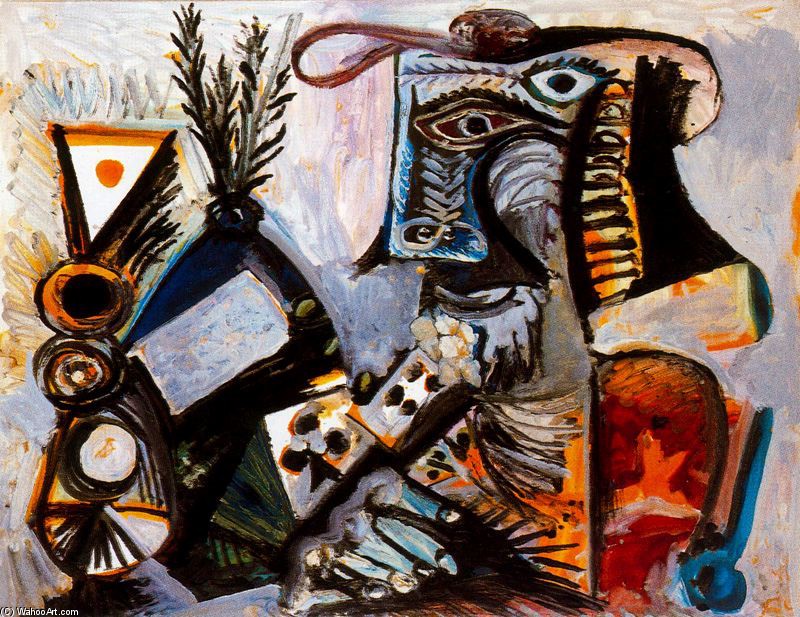
Pablo Picasso's "The Card Player," painted in 1913-14 during the formative years of his artistic breakthrough, stands as a pivotal work embodying the nascent principles of Cubism. Created amidst the turbulent backdrop of European intellectual ferment—the rise of Dada and Surrealism challenging established conventions—this painting transcends mere representation; it delves into psychological complexity and interrogates the very nature of perception.
- Subject Matter: The central figure, shrouded in a mask concealing his face, embodies anonymity and introspection. He sits alone at a table adorned with objects – a vase, a clock, and a bowl – creating an environment that reinforces feelings of solitude and detachment.
- Style & Technique: Picasso employs a revolutionary fracturing technique characteristic of Cubism’s early phase. Geometric planes intersect and overlap, disrupting traditional perspective and presenting multiple viewpoints simultaneously. This deliberate distortion aims to capture not just what is seen but also how it is perceived, reflecting the artist's preoccupation with dismantling illusion.
Symbolic Layers – Beyond Appearances
The mask itself serves as a potent symbol of concealment and identity—a motif recurrent throughout Picasso’s oeuvre. It speaks to themes of repression, hidden emotions, and the difficulty of achieving genuine self-awareness. The inclusion of objects like the vase, clock, and bowl adds layers of significance. These items represent time passing, stillness, and domesticity – elements juxtaposed against the figure's isolation, highlighting the tension between internal experience and external reality.
- Color Palette: Picasso utilizes a muted color scheme dominated by earthy tones—browns, ochres, and greys—contributing to the painting’s melancholic atmosphere. The subtle gradations of color enhance the sense of depth and create an illusionistic effect despite the geometric fragmentation.
Historical Context – Artistic Rebellion Amidst Crisis
Painted during a period marked by political instability—the escalating tensions leading up to World War I—"The Card Player" reflects Picasso’s engagement with intellectual currents of his time. Cubism emerged as a reaction against Impressionism and Post-Impressionism, rejecting their emphasis on capturing fleeting impressions of light and color. Instead, Picasso sought to represent objects from multiple viewpoints simultaneously, challenging viewers to reconsider their understanding of visual space.
- Influence: This painting profoundly impacted subsequent artistic movements, paving the way for Surrealism and Abstract Expressionism. Its innovative approach to composition and perspective continues to inspire artists today.
Emotional Resonance – A Meditation on Human Condition
"The Card Player" transcends its formal innovations to convey a profound emotional resonance. The figure’s solitary posture evokes feelings of vulnerability, contemplation, and perhaps even despair. Picasso's masterful manipulation of form and color invites viewers into a dialogue about the complexities of human experience—the struggle for self-expression amidst societal pressures and the inescapable awareness of mortality.
الأسئلة والأجوبة
هل يُعد "The Card-Player 1" للفنان بابلو بيكاسو عملاً فنياً مشهوراً؟
مستوى الشهرة المسجل لـ "The Card-Player 1" للفنان بابلو بيكاسو هو Iconic.
ما مدى قوة ألوان "The Card-Player 1"؟
تتميز لوحة "The Card-Player 1" للفنان بابلو بيكاسو بدرجة تشبع تبلغ Subtle Color وكثافة لونية تصل إلى Balanced.
عن ماذا يتحدث العمل "The Card-Player 1"، وما هو الطابع الذي يضفيه؟
تجمع لوحة "The Card-Player 1" للفنان بابلو بيكاسو بين mask, poker, chessboard, reflection, geometric, psychology, symbolism, portraiture وأجواء Dramatic.


 معاينة الحجم الواقعي
 اطلب نسخة مرسومة يدويًا
 إرسال
إرسال مشاركة
 عرض التفاصيل
 دليل الأعمال الفنية للطلاب

 تحميل
تحميل
 قطع مشابهة
 الأشعة السينية
 عرض شرائح متتابع
 Q&A
Q&A الإحصائيات
 اقرأ المزيد






































 خيار الزجاج متاح فقط للمقاسات التي تقل عن 110 سم