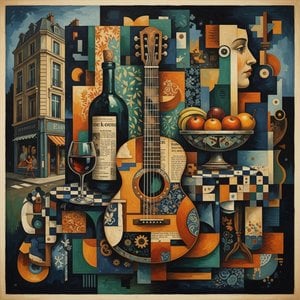
Pablo Picasso’s Still Life: A Fragment of Surrealist Vision
Pablo Picasso's "Still Life," painted in 1921, stands as a pivotal moment in the artist’s exploration of Cubism and its burgeoning influence on Surrealism. More than just an arrangement of objects—a cup, a book, paper, and scissors—it embodies Picasso’s relentless pursuit of capturing multiple perspectives simultaneously, mirroring the fractured realities inherent in the human psyche. This piece wasn't merely decorative; it was a deliberate challenge to traditional artistic conventions, signaling a dramatic departure from representational art toward abstraction.
- Subject Matter: The composition centers around commonplace items – familiar tools of daily life – elevating them to an almost monumental status. Picasso eschewed grand landscapes or mythological narratives, opting instead for the intimacy of the domestic sphere.
- Style & Technique: Executed in Picasso’s Synthetic Cubism style, “Still Life” exemplifies the technique's core principles. Unlike Analytical Cubism which dissected objects into geometric planes, Synthetic Cubism reconstructed them from fragments of flattened surfaces and superimposed textures. This approach aimed to convey not just what an object *looked* like but also how it *felt*, injecting emotion into the visual realm.
Historical Context: The Dawn of Surrealist Influence
Painted during a period of intense artistic experimentation, “Still Life” anticipates the stylistic developments that would characterize Surrealism. Picasso’s embrace of fragmented forms and dreamlike imagery aligns perfectly with André Breton's manifesto of 1924, which championed irrationality and automatism as pathways to unlocking subconscious creativity. The artwork reflects the broader cultural anxieties of the time – a reaction against rational thought and a fascination with the hidden depths of human experience.
- Symbolism: While seemingly simple on the surface, “Still Life” is laden with symbolic resonance. The objects themselves—the cup, representing nourishment and comfort; the book, symbolizing knowledge and contemplation; the paper, signifying communication and fragility—suggest a meditation on human existence and its inherent contradictions.
- Color Palette: Picasso employed a muted color palette dominated by earthy tones – browns, ochres, and creams – creating an atmosphere of quiet solemnity. This restrained coloration underscores the artwork’s contemplative mood and emphasizes the textural qualities of the surfaces.
Emotional Impact & Artistic Legacy
“Still Life” transcends mere visual representation; it communicates a profound emotional depth. Picasso's masterful manipulation of perspective and texture invites viewers to engage in an imaginative dialogue with the artwork, prompting reflection on themes of memory, loss, and transformation. It remains a cornerstone of Picasso’s oeuvre—a testament to his unwavering commitment to pushing artistic boundaries and redefining what constitutes beauty. Its influence can be seen throughout subsequent generations of artists who sought to explore similar stylistic approaches.
الأسئلة والأجوبة
ما مدى إشراق "Still life" بشكل عام؟
بشكل عام، تم تسجيل درجة السطوع لـ "Still life" بـ shadow. ويصف السطوع المدرك مدى ظهور العمل الفني كضوء أو عتمة.
ما هو تنسيق "Still life"؟
تتميز لوحة "Still life" للفنان بابلو بيكاسو بتنسيق Panoramic. ويصف هذا التنسيق أبعاد التكوين الفني.
كم عدد الأشخاص الذين يشاهدون "Still life"؟
تعرض صفحة الإحصائيات الخاصة بـ "Still life" للفنان بابلو بيكاسو إحصائيات الزيارات العامة: عدد الزيارات الشهرية لهذا العمل الفني، ومقارنةً مع أكثر أعمال الفنان مشاهدةً، بالإضافة إلى المناطق التي يأتي منها الزوار.



 معاينة الحجم الواقعي
 اطلب نسخة مرسومة يدويًا
 إرسال
إرسال مشاركة
 عرض التفاصيل
 دليل الأعمال الفنية للطلاب

 تحميل
تحميل
 قطع مشابهة
 الأشعة السينية
 عرض شرائح متتابع
 الإحصائيات

 اقرأ المزيد






































 خيار الزجاج متاح فقط للمقاسات التي تقل عن 110 سم