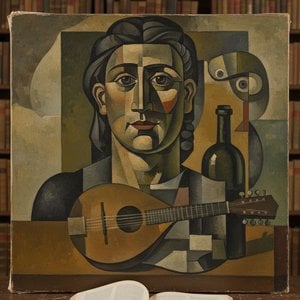
Seated Female Nude: A Bridge Between Cézanne and African Inspiration
Pablo Picasso’s *Seated Female Nude*, completed in 1908, stands as a pivotal moment in the artist's artistic evolution—a testament to his burgeoning fascination with both Paul Cézanne’s groundbreaking approach to form and space and the expressive power of African sculpture. More than just a portrait, it embodies Picasso’s pioneering experimentation with Cubism, marking a decisive step away from traditional representation towards a radically new visual language.
The painting depicts a nude female figure seated on what appears to be a stool, her legs crossed in an uneasy posture that subtly conveys discomfort and tension. Picasso deliberately fragmented the form of his model—a woman known as Marie Therese Walter—employing techniques reminiscent of Cézanne’s late landscapes and portraits where he sought to capture multiple perspectives simultaneously. As Picasso himself famously declared Cézanne “my one and only master,” this influence is palpable in *Seated Female Nude*. Just like Cézanne's monumental bather compositions, Picasso eschewed meticulous detail, prioritizing instead the depiction of intersecting planes and contours that suggest depth without resorting to conventional shading. The artist’s bold brushstrokes—heavy with rusty brown and tan paint—create a textured surface that contributes to the painting’s sculptural quality.
However, *Seated Female Nude* transcends mere stylistic imitation; it actively engages with the artistic traditions of Africa, Iberia, and Oceania – an exploration Picasso initiated during his visits to museums and private collections in 1907. The Musée d’Ethnographier du Trocadéro in Paris profoundly impacted Picasso's thinking about art, prompting him to articulate a revolutionary concept: “Painting isn’t an aesthetic process,” he explained, “it’s a form of magic designated as a mediator between this strange, hostile world and us…. When I came to that realization, I knew I had found my way.” This epiphany fueled Picasso's artistic endeavors throughout 1908, resulting in numerous paintings and sculptures infused with earthy tones and simplified geometric shapes—a direct response to the monumental head from Easter Island installed at the Muséum national d’histoire naturelle.
The artist’s companion Fernande Olivier recounted vivid memories of their explorations of the Jardin des Plantes, describing Picasso's intense engagement with the sculptural forms of Oceanic art: “He took us there several times at night,” she wrote, “Everything would become so mysterious that we were almost afraid.” This encounter solidified Picasso’s conviction that art could transcend mere visual representation, serving as a conduit for confronting existential anxieties and fostering empathy.
Furthermore, Picasso's preoccupation with Cézanne’s influence is evident in the deliberate distortions of form—the elongated left hand far surpassing her right, the unnaturally bent left leg—which underscore his sculptural ambition. These stylistic choices aren’t merely decorative; they represent a conscious effort to liberate the figure from the constraints of traditional perspective and anatomical accuracy. The painting's background palette—greens and gray—mirrors Picasso’s broader artistic explorations during the spring and summer of 1908, reflecting his ongoing engagement with both Cézanne’s legacy and the transformative potential of non-Western art.
Ultimately, *Seated Female Nude* embodies Picasso’s groundbreaking synthesis of Cubism and African inspiration—a visual manifesto that signaled a radical departure from artistic conventions and cemented his position as one of the most influential artists of the twentieth century. Its monumental figure, rendered in gauzy layers of scumbled strokes and thin washes of browns and tans, continues to captivate viewers with its evocative beauty and profound psychological depth.



 معاينة الحجم الحقيقي
 اشترِ لوحة مرسومة يدويًا
 مشاركة
 مشاركة
 التفاصيل

 تحميل الملف
 قطع مشابهة
 الأشعة السينية
 عرض شرائح
 الإحصائيات


 عرض المزيد






































 خيار الزجاج متاح فقط للمقاسات التي تقل عن 110 سم