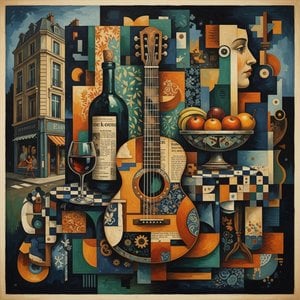
A Fragmented Harmony
In 1913, Pablo Picasso moved away from the meticulous dissection of objects seen in Analytical Cubism toward the layered approach of Synthetic Cubism. In this work, the clarinet and violin are not rendered through traditional perspective but are instead reconstructed as a series of overlapping geometric planes, cylinders, and cubes. The forms interpenetrate, presenting multiple viewpoints simultaneously to create an illusionistic depth that defies a single, unified gaze. This technique breaks down the contours of the instruments, suggesting their presence from various angles without relying on anatomical accuracy.
The composition incorporates several disparate elements that ground the abstract forms. A bottle sits in quiet contrast to the dynamic energy of the musical instruments, while a clock introduces the concept of temporal progression. The inclusion of a newspaper brings a sense of contemporary communication and information into the frame. Near the center-left, a chair provides a structural anchor to the scene, and an ace of clubs adds a subtle note of chance or unpredictability to the arrangement.
Symbolism and Atmosphere
The painting functions as a reflection of the intellectual and psychological climate following World War I. The fragmentation of the violin and clarinet mirrors a sense of disorientation and the fractured reality of the era. Through the use of oil paint on canvas, layers of color and texture are built up to achieve subtle gradations of tone. This manipulation of light and shadow contributes to an atmosphere of contemplation and unease.
Beyond the formal experimentation, the objects within the piece carry specific weights. The stillness of the bottle contrasts with the implied movement of the music, while the clock and newspaper suggest a preoccupation with mortality and societal change. The resulting image is one of complexity, where the tension between the recognizable objects and their distorted shapes captures the anxieties of a period in flux.
الأسئلة والأجوبة
هل تبدو ألوان "Clarinet and Violin" قوية أم هادئة؟
تُظهر لوحة "Clarinet and Violin" للفنان بابلو بيكاسو كثافة لونية Balanced.
ما مدى سطوع "Clarinet and Violin" للفنان بابلو بيكاسو؟
من حيث السطوع الملحوظ، فإن "Clarinet and Violin" للفنان بابلو بيكاسو يتميز بـ brilliant.
ما هو الانطباع العام لـ "Clarinet and Violin" للفنان بابلو بيكاسو؟
يُوصف العمل الفني "Clarinet and Violin" للفنان بابلو بيكاسو بأنه Dramatic من حيث الحالة المزاجية، ويمكن لهذا التصنيف أن يساعد في اختيار المكان الأنسب لعرضه.



 معاينة الحجم الواقعي
 اطلب نسخة مرسومة يدويًا
 إرسال
إرسال مشاركة
 عرض التفاصيل
 دليل الأعمال الفنية للطلاب

 تحميل
تحميل
 قطع مشابهة
 الأشعة السينية
 عرض شرائح متتابع
 الإحصائيات

 اقرأ المزيد






































 خيار الزجاج متاح فقط للمقاسات التي تقل عن 110 سم