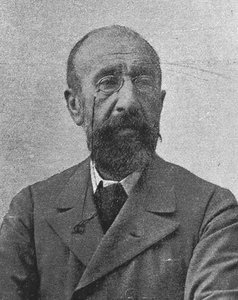
A Legacy of Vision: The Life and Art of Osman Hamdi Bey
In the grand tapestry of late Ottoman history, few figures loom as large or as multifaceted as Osman Hamdi Bey. Born on December 30, 1842, into the upper echelons of Istanbul’s aristocracy—the eldest son of the Grand Vizier Ibrahim Edhem Pasha—Hamdi Bey was destined for a life of profound influence. His journey, however, was not merely one of inherited status but of self-forged intellectual mastery. While his early years were shaped by the political shifts of the Ottoman Empire, it was his immersion in the vibrant, academic atmosphere of Paris that would forever alter the course of Turkish art. Sent to France in 1860 to study law, the allure of the Seine and the burgeoning Impressionist movement redirected his destiny from the courtroom to the canvas, allowing him to absorb the rigorous techniques of Western academic realism.
Under the tutelage of masters such as Jean-Léon Gérôme and Gustave Boulanger, Hamdi Bey developed a meticulous command over light, texture, and form. Yet, he did not merely mimic the European style; instead, he performed a brilliant act of cultural synthesis. He utilized the tools of Western Orientalism to re-examine his own heritage through a lens of scholarly dignity and profound introspection. His work moved away from the exoticized, often superficial depictions of the East common in European studios, opting instead for a deeply nuanced portrayal of Ottoman life, intellect, and spirituality. Through his brush, the East was not an object of curiosity, but a subject of complex, lived reality.
The Painter as Scholar: Symbolism and Technique
To gaze upon a masterpiece by Osman Hamdi Bey is to enter a space of quiet contemplation and historical depth. His paintings are often characterized by a sense of stillness, where every object—a tile, a manuscript, or a flickering lamp—carries the weight of symbolic significance. In his most celebrated work, The Tortoise Trainer (1906), we see the pinnacle of this meditative approach. The painting, which many believe serves as a self-portrait, depicts an elderly man in the dignified robes of a dervish, engaged in the seemingly impossible task of training slow-moving tortoises. Here, the artist employs a sophisticated use of impasto and light to create a palpable sense of atmosphere, using the scene as a profound metaphor for the patience required for social reform and the slow, arduous progress of civilization.
His technical prowess extended into portraiture and genre painting, where he captured the essence of his subjects with startling realism. In works like Kokona Despina, the viewer is confronted with a weathered visage rendered with such precision that the very texture of time feels etched into the canvas. His ability to manipulate light—often casting soft, defining shadows that grant his figures a sculptural three-dimensionality—allows him to breathe life into the historical settings he depicts. Whether portraying the scholarly gravity of The Scholar or the intimate grace of Portrait of Naile Hanım, Bey’s work remains anchored in a deep respect for the human condition and the architectural splendor of his era.
Architect of Modernity: The Archaeologist and Museologist
Beyond the confines of the studio, Osman Hamdi Bey was a titan of institutional progress. He recognized that for a nation to move forward, it must first understand its foundations. As a pioneering archaeologist and administrator, he played an instrumental role in establishing the scientific study of the past within the Ottoman Empire. His tireless efforts led to the creation of the Istanbul Archaeology Museums, providing a sanctuary for the empire's vast and precious antiquities. By implementing legislation to regulate archaeological finds, he protected the cultural heritage of Anatolia from being lost to the tides of unregulated excavation.
His contributions to education were equally transformative. As the founder of the Istanbul Academy of Fine Arts (now known as Mimar Sinan Fine Arts University), he laid the groundwork for formal art education in Turkey, ensuring that future generations would have access to the same rigorous training that had shaped him. His legacy is thus twofold: he was both a creator of beauty and a protector of history. Through his dual roles as a painter and a museologist, Osman Hamdi Bey bridged the gap between the traditions of the East and the academic rigor of the West, leaving behind an indelible mark on the cultural identity of a modernizing nation.



 معاينة الحجم الحقيقي
 اشترِ نسخة مطبوعة
 مشاركة
 مشاركة
 التفاصيل

 تحميل الملف
 قطع مشابهة
 الأشعة السينية
 عرض شرائح
 عرض المزيد






































 خيار الزجاج متاح فقط للمقاسات التي تقل عن 110 سم