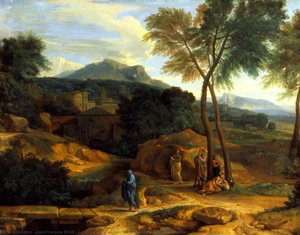
Landscape with Polyphemus
Nicolas Poussin’s Landscape with Polyphemus stands as a cornerstone of Baroque art and exemplifies the artist’s masterful command of classical ideals translated into visual splendor. Painted in 1648 for Jean Pointel, this monumental oil on canvas resides within the hallowed halls of The Hermitage Museum in St. Petersburg, Russia—a repository of artistic treasures reflecting centuries of cultural heritage.
At 150 x 199 cm, the painting immediately impresses with its serene grandeur and deliberate composition. Poussin eschewed the flamboyant excesses characteristic of his contemporaries, opting instead for a harmonious balance achieved through meticulous observation and intellectual contemplation. The scene depicts a mythological narrative—a retelling of Homer’s Odyssey—featuring Polyphemus, the cyclops son of Poseidon, wrestling with Galatea, a nymph from Arcadia. This juxtaposition of pagan mythology and idealized landscape is quintessential Poussinian style.
The artist skillfully employs linear perspective to create depth and realism within this fantastical setting. Foreground elements—a rocky outcrop and scattered shrubs—are rendered with painstaking detail, anchoring the viewer’s gaze while simultaneously framing a panoramic vista stretching into the distance. Two horses dominate the right side of the composition, symbolizing nobility and strength, and their placement contributes to the overall sense of balance.
Central to the painting is Polyphemus himself—a figure rendered with remarkable anatomical accuracy despite his monstrous appearance. He holds a bow and arrow, poised for action yet imbued with an air of melancholy contemplation. The inclusion of Galatea and her attendants underscores themes of beauty, innocence, and divine grace – concepts deeply rooted in classical philosophy.
Beyond its aesthetic merits, Landscape with Polyphemus speaks to a broader artistic and intellectual tradition. Poussin’s unwavering devotion to classical principles—particularly those championed by Raphael—influenced generations of artists who sought to emulate his clarity, elegance, and profound understanding of human emotion. The painting's enduring appeal lies in its ability to transport the viewer to another realm—a realm where mythic grandeur intertwines with sublime natural beauty.
The Hermitage Museum’s acquisition of this masterpiece solidified its place within Russia’s artistic canon. Alongside other celebrated works by Poussin, such as The Holy Family with St. Elizabeth and John the Baptist—also housed in St. Petersburg—demonstrates Poussin’s lasting impact on European art history.
For those wishing to experience the majesty of Landscape with Polyphemus firsthand, WahooArt.com offers exquisitely crafted oil painting reproductions that faithfully capture the essence and luminosity of Poussin’s original vision.
References: Translated from the equivalent article on Russian Wikipedia List of paintings by Arnold Böcklin:
https://en.wikipedia.org/wiki/List_of_paintings_by_Arnold_B%C3%B6cklin
الأسئلة والأجوبة
ما هي أبعاد العمل الأصلي "Landscape with Polyphemus"؟
تبلغ أبعاد "Landscape with Polyphemus" في شكلها الأصلي 150 x 199 cm. وتُعد الأبعاد الأصلية مرجعاً مفيداً عند اختيار حجم النسخة المطبوعة.
من أين يأتي زوار "Landscape with Polyphemus" للفنان نيكولا بوزان؟
تعرض صفحة الإحصائيات الخاصة بـ "Landscape with Polyphemus" للفنان نيكولا بوزان إحصائيات الزيارات العامة: عدد الزيارات الشهرية لهذا العمل الفني، ومقارنةً مع أكثر أعمال الفنان مشاهدةً، بالإضافة إلى المناطق التي يأتي منها الزوار.
كيف يمكنني تحميل صورة "Landscape with Polyphemus" للفنان نيكولا بوزان؟
يتوفر خيار التنزيل لـ "Landscape with Polyphemus": حيث توفر صفحة تحميل الخاصة بالعمل الفني تحميل صورة رقمية عالية الدقة.
من الذي يبيع نسخاً مرسومة يدوياً من "Landscape with Polyphemus" للفنان نيكولا بوزان؟
تتوفر نسخة "Landscape with Polyphemus" المرسومة يدوياً عبر نسخة زيتية مرسومة يدوياً على قماش الكتان. ويمكن تقديم الطلب من خلال هذه الصفحة، مع إمكانية اختيار أحجام مختلفة.
متى تم إنجاز "Landscape with Polyphemus"؟
يعود تاريخ إبداع "Landscape with Polyphemus" للفنان نيكولا بوزان إلى عام 1648.
ما هي التقنية المستخدمة في "Landscape with Polyphemus" للفنان نيكولا بوزان؟
تعتمد التقنية المستخدمة في "Landscape with Polyphemus" للفنان نيكولا بوزان على أكريليك على كانفاس. وتهدف النسخ المطبوعة إلى محاكاة مظهر هذه التقنية.
إلى أي مرحلة من مسيرة نيكولا بوزان الفنية ينتمي العمل "Landscape with Polyphemus"؟
ضمن مسيرة نيكولا بوزان المهنية، تندرج لوحة "Landscape with Polyphemus" ضمن مرحلة Mature Period. وتساعد هذه المرحلة في مقارنتها بأعمال الفنان الأخرى.
من هو مؤلف "Landscape with Polyphemus" وفي أي عام أُنتج؟
مؤلف "Landscape with Polyphemus" هو نيكولا بوزان، ويعود تاريخ العمل إلى 1648.



 معاينة الحجم الواقعي
 اطلب نسخة مرسومة يدويًا
 إرسال
إرسال مشاركة
 عرض التفاصيل
 دليل الأعمال الفنية للطلاب

 تحميل
تحميل
 قطع مشابهة
 الأشعة السينية
 عرض شرائح متتابع
 الإحصائيات


 اقرأ المزيد






































 خيار الزجاج متاح فقط للمقاسات التي تقل عن 110 سم