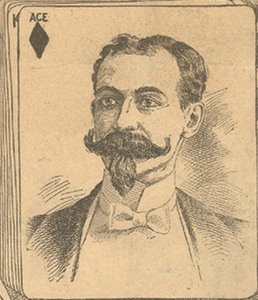
السيرة الذاتية للفنان
Merton Clivette: A Bohemian Pioneer of American Expressionism
Merton Clive Cook (11 June 1868 – 8 May 1931), known universally as Merton Clivette, was an American painter whose life spanned a remarkable journey from acrobatic performances in the Wild West to establishing himself as one of New York’s foremost artists during the Ashcan School era and beyond. His distinctive style—characterized by bold brushwork, dramatic chiaroscuro contrasts, and a fascination with both Native American subjects and theatrical figures—solidified his place within the artistic landscape of early 20th century America.
Early Life and Artistic Beginnings
Born in Portage, Wisconsin, Clivette’s formative years were spent traversing the American frontier alongside his family, immersing himself in the spectacle of circuses and honing skills as an acrobat, juggler, and magician—a skillset that would inform his later artistic approach. Notably, he studied under Auguste Rodin at the École Supérieure des Beaux-Arts in Paris between 1889 and 1890, absorbing influences from sculptural realism and forging a connection with European artistic traditions. This early exposure to Rodin’s masterful technique instilled in him a disciplined eye for form and composition—a cornerstone of his subsequent oeuvre. He began his own circus tour in 1890 and joined the Orpheum Circuit to tour with them from 1891-1900. During this time he officially adopted the name Clivette, and billed himself “Clivette, the Man in Black”.
The Vaudeville Years and European Travels
His theatrical inclinations propelled him into a prolific vaudeville career, traversing Europe and Asia with captivating performances that blended acrobatics, illusionism, and storytelling. These travels broadened his artistic horizons, exposing him to diverse cultures and inspiring him to explore themes of spectacle and performance within his paintings. He married Catherine Parker Chamberlain in New York in 1896, and her acts were incorporated into his show. The family moved to New York, where Merton gave up his stage career and began to paint full time. Clivette was an active part of the artist community there, participating in symposiums and workshops at the Art Students League, being a member of the Society of Independent Artists, and befriending other artists.
The Ashcan School and Native American Portraits
Clivette’s artistic breakthrough arrived during the Ashcan School movement—a rebellious reaction against academic art that championed gritty realism depicting urban life and marginalized communities. Influenced by Robert Henri and fellow Ashcan painters, he embraced a bold stylistic vision prioritizing expressive brushwork and capturing the essence of human experience with unflinching honesty. He skillfully employed chiaroscuro techniques to heighten dramatic impact, mirroring the theatrical flair of his performances. Furthermore, Clivette developed a profound interest in Native American subjects, producing evocative portraits that conveyed both respect for cultural heritage and an exploration of psychological depth—a stylistic divergence from Ashcan realism that nonetheless retained his signature expressive style.
Later Career and Artistic Evolution
Throughout the 1920s Clivette’s work continued to evolve, drawing inspiration from artists like Franz Kline and embracing abstraction as he moved away from traditional representation. His paintings became increasingly characterized by loose, energetic brushstrokes—a deliberate departure from Rodin's sculptural precision—reflecting a desire to capture spontaneous emotion and conveying the dynamism of his artistic vision. George S. Hellman writes that Clivette was the greatest American Painter ever after seeing Clivette’s “Out”. His legacy resides in his pioneering spirit, his unwavering commitment to expressive painting, and his enduring fascination with capturing the complexities of human experience—a testament to a life dedicated to art and performance.



 معاينة الحجم الحقيقي
 اشترِ لوحة مرسومة يدويًا
 مشاركة
 مشاركة
 التفاصيل

 تحميل الملف
 قطع مشابهة
 الأشعة السينية
 عرض شرائح
 عرض المزيد






































 خيار الزجاج متاح فقط للمقاسات التي تقل عن 110 سم