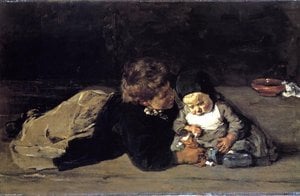
A Window Into Liebermann’s Soul: Examining ‘Self Portrait with Hat, Brush, and Palette’
Max Liebermann's “Self Portrait with Hat, Brush, and Palette,” completed in 1934, stands as a quintessential example of Impressionist painting—a genre defined by capturing fleeting moments of light and color rather than striving for photographic realism. More than just a depiction of the artist himself, this artwork offers a profound glimpse into Liebermann’s artistic sensibilities and his engagement with the intellectual currents shaping early 20th-century Germany.
The painting itself is rendered in muted shades of brown, ochre, and gray—a deliberate choice that reflects Liebermann's fascination with tonal harmonies and his desire to convey a sense of quiet contemplation. The artist sits calmly before a easel, wearing a straw hat and holding a paintbrush and palette – symbols of his craft and profession. Light filters softly through the window behind him, illuminating his face and casting subtle shadows across his attire. Liebermann’s gaze is directed outwards, suggesting an awareness of the world beyond the confines of his studio.
Liebermann's stylistic approach aligns perfectly with the Impressionist movement’s rejection of academic conventions. He eschews meticulous detail in favor of loose brushstrokes and blended pigments—techniques that prioritize capturing the ephemeral qualities of light and atmosphere. This technique is particularly evident in the depiction of the windowpane, where Liebermann skillfully renders the refracted sunlight using broken color patches.
Historical Context: The Rise of Modernism
“Self Portrait with Hat, Brush, and Palette” emerged during a period of significant artistic upheaval—the burgeoning Impressionist movement challenged the dominance of Romantic idealism and paved the way for subsequent avant-garde movements. Liebermann’s work reflects this broader cultural shift toward embracing experimentation and prioritizing subjective experience.
The painting was created in Berlin, which at the time was experiencing rapid industrialization and urbanization—forces that profoundly impacted artistic sensibilities. Liebermann's engagement with these developments is palpable in his depiction of the domestic interior—a space imbued with a sense of understated elegance and intellectual curiosity. The artist’s studio serves as a microcosm of the broader modernist ethos, embodying a commitment to capturing the complexities of contemporary life.
Symbolism Beyond Appearance
Beyond its visual qualities, “Self Portrait with Hat, Brush, and Palette” is laden with symbolic significance. The hat represents Liebermann's identity—a marker of social status and profession—while the paintbrush and palette symbolize his creative vocation. The muted color palette contributes to a mood of introspection and serenity, inviting viewers to contemplate the artist’s inner life.
Furthermore, Liebermann’s gaze outward suggests an awareness of the world beyond the easel—a recognition that art should engage with broader social and philosophical concerns. This subtle gesture underscores the painting's enduring relevance as a meditation on the relationship between artist and subject, intellect and emotion.
Emotional Resonance: Quiet Reflection
"Self Portrait with Hat, Brush, and Palette" succeeds in conveying a powerful emotional resonance—a sense of quiet contemplation and understated beauty. Liebermann’s masterful handling of light and color creates an atmosphere of tranquility that draws the viewer inward, prompting reflection on themes of identity, creativity, and perception.
The painting's enduring appeal lies in its ability to capture a moment of profound stillness—a reminder that art can offer solace and inspiration amidst the turbulence of modern life. It remains a testament to Liebermann’s artistic vision and his unwavering commitment to portraying the human experience with sensitivity and insight.
الأسئلة والأجوبة
ما هي الاستخدامات والمساحات الموصى بها لـ "Self-Portrait" للفنان ماكس ليبرمان؟
يُنصح بوضع "Self-Portrait" للفنان ماكس ليبرمان لغرض Accent، ويُفضل أن يكون ذلك في Living Room. إن الجمع بين طريقة الاستخدام والمساحة المتاحة يساعد في تحديد المكان الأمثل لوضع هذه النسخة الفنية.
كيف يمكنني الحصول على نسخة رقمية من "Self-Portrait" للفنان ماكس ليبرمان؟
للحصول على نسخة رقمية من "Self-Portrait" للفنان ماكس ليبرمان، يمكنك طلب تحميل صورة رقمية عالية الدقة عبر صفحة صورة رقمية.
ما هو الحجم والاتجاه الموصى بهما لطباعة "Self-Portrait"؟
مقاس Large، واتجاه Portrait: هذا هو إعداد الطباعة المقترح لـ "Self-Portrait" للفنان ماكس ليبرمان.



 معاينة الحجم الواقعي
 اطلب نسخة مرسومة يدويًا
 إرسال
إرسال مشاركة
 عرض التفاصيل
 دليل الأعمال الفنية للطلاب

 تحميل
تحميل
 قطع مشابهة
 الأشعة السينية
 عرض شرائح متتابع
 الإحصائيات


 اقرأ المزيد






































 خيار الزجاج متاح فقط للمقاسات التي تقل عن 110 سم