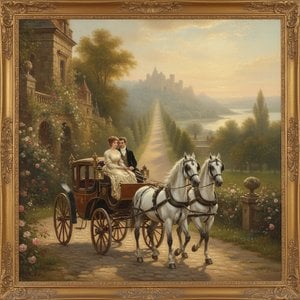
A Dreamscape Unveiled: Exploring Max Ernst’s “Family Excursions”
Max Ernst's 1919 painting, "Family Excursions," isn't merely a depiction of a domestic scene; it’s an invitation into the unsettling and profoundly evocative world of Surrealism. This work, measuring a modest 36 x 26 centimeters, pulsates with a dreamlike quality, achieved through Ernst’s masterful manipulation of juxtaposition and his pioneering use of techniques like frottage – a method he would later refine – to create textures that seem to breathe beneath the surface. The painting immediately arrests the viewer with its peculiar arrangement: a group of figures gathered around a dining table, an unexpected presence of a horse positioned on the left, and a carefully curated collection of objects—bowls, cups, vases—that collectively suggest a scene both familiar and utterly bizarre.
At first glance, "Family Excursions" appears to be a snapshot of everyday life. However, Ernst deliberately disrupts this sense of normalcy through the illogical placement of elements and the overall atmosphere of disorientation. The horse, for instance, is not simply an animal; it feels like a symbolic intrusion, a reminder of primal instincts lurking beneath the veneer of civilization. The figures themselves are rendered with a degree of ambiguity, their expressions obscured, their identities somewhat lost within the painting’s dreamlike logic. This deliberate vagueness invites the viewer to project their own interpretations and anxieties onto the scene, transforming it into a mirror reflecting our own subconscious.
Techniques of Illusion: Ernst's Pioneering Approach
Ernst was a relentless innovator, constantly experimenting with new methods to unlock the hidden potential of his art. “Family Excursions” exemplifies this spirit, showcasing his early explorations into techniques designed to disrupt traditional representation. While not directly utilizing frottage in its final form here, the painting’s textured surfaces—the subtly rendered tablecloth, the implied volume of the objects on the table—hint at Ernst's fascination with creating tactile illusions through rubbing and layering. This technique, developed later, allowed him to capture the essence of textures – wood grain, fabric, stone – in a way that defied conventional brushwork.
Furthermore, the painting’s composition is carefully constructed to create a sense of spatial ambiguity. The perspective seems slightly off-kilter, and the objects on the table are arranged in a manner that defies gravity and logic. This deliberate distortion contributes to the overall feeling of unease and disorientation, characteristic of Surrealist art. Ernst wasn't interested in simply replicating reality; he sought to expose its underlying anxieties and contradictions through carefully orchestrated visual paradoxes.
A Reflection of a Turbulent Era
To fully appreciate “Family Excursions,” it’s crucial to understand the historical context in which it was created. Painted in 1919, shortly after the end of World War I, the painting reflects the widespread disillusionment and uncertainty that gripped Europe at the time. Ernst's Dadaist roots are evident in his rejection of traditional artistic conventions and his embrace of absurdity and chance. The war had shattered established values and beliefs, leaving a generation grappling with trauma and questioning the nature of reality itself.
The inclusion of the horse can be interpreted as a symbol of both primal instincts and the destructive forces unleashed by the conflict. It’s a reminder that beneath the surface of civilized society lie darker, more fundamental impulses. “Family Excursions” isn't simply a charming domestic scene; it’s a powerful meditation on the anxieties and uncertainties of a world in transition – a testament to Max Ernst’s ability to capture the essence of his time through a uniquely surreal lens.
Collecting the Dream: A Reproduction for Your Space
WahooArt offers meticulously crafted, hand-painted reproductions of “Family Excursions,” allowing you to bring this iconic Surrealist masterpiece into your home or office. Our skilled artists replicate Ernst’s intricate textures and evocative atmosphere with exceptional detail, ensuring that the reproduction captures the painting's original power and beauty. Whether you are an art enthusiast, a collector seeking to expand your collection, or simply someone drawn to the captivating imagery of Surrealism, our reproductions provide a stunning way to experience this seminal work of art.
Each reproduction is created on high-quality canvas using archival pigments, guaranteeing its longevity and vibrancy. Available in various sizes, you can choose the perfect scale to complement your space and personal style. Explore our selection today and immerse yourself in the dreamlike world of Max Ernst’s “Family Excursions.”



 معاينة الحجم الحقيقي
 التحويل إلى المطبوعات
 مشاركة
 مشاركة
 التفاصيل
 الدليل

 تحميل الملف
 قطع مشابهة
 الأشعة السينية
 عرض شرائح
 الإحصائيات


 عرض المزيد






































 خيار الزجاج متاح فقط للمقاسات التي تقل عن 110 سم