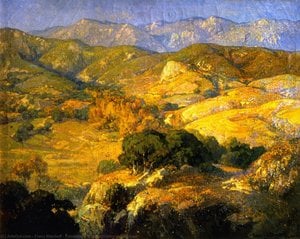
The Luminous Spirit of Maurice Braun
In the golden light of the American West, few artists captured the profound intersection of landscape and spirituality as poignantly as Maurice Braun. Born in 1877 within the historic borders of the Kingdom of Hungary, Braun’s journey was one of migration and metamorphosis. Arriving in New York City at the tender age of four, his early years were steeped in the vibrant textures of Hungarian Jewish culture, a heritage that provided a rich emotional foundation for his later explorations of the universal connection between humanity and the natural world. His formal artistic odyssey began at the prestigious National Academy of Design, where he refined his craft under the guidance of masters such as Francis C. Jones and George W. Maynard. This rigorous training in the French tradition instilled in him a technical precision that would eventually serve as the scaffolding for his more fluid, impressionistic experiments.
As his artistic identity matured, Braun’s focus shifted from the structured world of portraiture toward the boundless horizons of the landscape. A pivotal moment in his development was his encounter with Theosophy, a spiritual philosophy that seeks to find harmony between religious thought and the natural universe. This belief became the heartbeat of his creative process; for Braun, a mountain range or a coastal vista was not merely a subject for visual documentation but a sacred manifestation of divine energy. This spiritual yearning eventually drew him away from the bustling streets of New York toward the sun-drenched landscapes of Southern California in 1909. In San Diego, he found a "natural paradise" where the brilliant atmospheric light and dramatic topography offered the perfect canvas for his burgeoning Impressionist style.
A Master of Light and Atmosphere
The work of Maurice Braun is characterized by an exquisite ability to translate the ephemeral qualities of light into enduring oil on canvas. Moving beyond simple representation, he employed loose, rhythmic brushstrokes and a luminous color palette to evoke the emotional resonance of the California coast. His compositions often dance between the tangible and the ethereal, capturing the way sunlight dissolves the edges of distant mountains or how mist clings to a quiet harbor. Whether depicting the rugged grandeur of a desert panorama or the tranquil movement of boats in a sheltered bay, Braun’s technique remained deeply rooted in the pursuit of atmospheric truth.
His mastery was not merely a matter of personal vision but was recognized by the highest echelons of the art world during his lifetime. The following milestones underscore his professional ascent:
- The Hallgarten Prize: Awarded by the National Academy of Design in 1900, marking him as a rising talent in the American art scene.
- Gold Medal at the Panama–California Exposition (1915–16): A definitive achievement that cemented his reputation as a premier painter of the California landscape.
- Prestigious Memberships: His active participation in the Salmagundi Club in Manhattan and the Laguna Beach Art Association connected him to a vital network of influential American Impressionists.
Legacy and Enduring Resonance
Though his life came to an end in San Diego in 1941, the legacy of Maurice Braun continues to glow with the same intensity as the landscapes he loved. He remains a cornerstone figure of early California Impressionism, a movement that sought to define a unique American aesthetic through the lens of regional light and topography. His ability to weave the spiritual threads of Theosophy into the very fabric of his landscapes ensures that his work transcends mere nostalgia, offering instead a meditative experience for the modern viewer.
Today, Braun’s canvases serve as vital historical windows into a bygone era of American art, preserved in some of the most esteemed institutions across the United States. His presence is felt in the permanent collections of:
- The Los Angeles County Museum of Art (LACMA)
- The San Diego Museum of Art and the San Diego History Center
- The Irvine Museum and the Laguna Beach Art Museum
- The Long Beach Museum of Art and the Houston Museum
Through these collections, Braun’s vision of a harmonious, light-filled world remains accessible, inviting every generation to rediscover the soul of the California landscape through his masterful eyes.



 معاينة الحجم الحقيقي
 التحويل إلى المطبوعات
 مشاركة
 مشاركة
 التفاصيل
 الدليل

 تحميل الملف
 قطع مشابهة
 الأشعة السينية
 عرض شرائح
 الإحصائيات
 عرض المزيد






































 خيار الزجاج متاح فقط للمقاسات التي تقل عن 110 سم