A Profound Resonance: Unpacking Mark Rothko's "White and Greens in Blue"
Mark Rothko’s “White and Greens in Blue,” painted in 1957, isn’t merely a painting; it’s an invitation. An invitation to surrender to the quiet intensity of color, to contemplate the vastness within, and perhaps, to glimpse something akin to the divine. Born Markus Yakovlevich Rothkowitz in Dvinsk, Latvia – a landscape steeped in both beauty and historical turmoil – Rothko carried with him from his earliest years a profound sensitivity to human suffering, a theme that would become a recurring motif throughout his career. This early experience of displacement, coupled with his family’s intellectual and political engagement, shaped an artist deeply attuned to the complexities of existence.
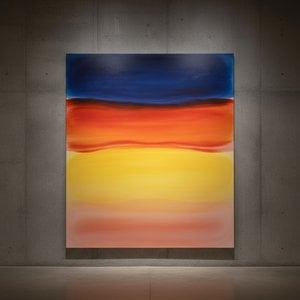
The painting itself is deceptively simple at first glance. Three horizontal rectangles – a dominant dark green, a luminous white, and a subtle blue – float within a deep field of color. These aren't sharply delineated forms; rather, they bleed into one another, creating an atmosphere of hazy contemplation. The technique employed is characteristic of Rothko’s “Color Field” style: broad, unmodulated washes of pigment applied with a remarkable lack of detail. He eschewed traditional brushwork, opting instead for a process of layering and blending that results in surfaces that seem to shimmer and vibrate. This deliberate flatness – the rejection of illusionistic depth – forces the viewer to engage directly with the color itself, creating an immersive experience.
The Language of Color: Symbolism and Emotional Depth
While Rothko famously resisted definitive interpretations of his work, art historians and critics have consistently identified powerful symbolic resonances within “White and Greens in Blue.” The dark green rectangle, often described as a ‘void,’ represents the unknown, the unconscious, or perhaps even death. It’s a space of profound darkness, yet paradoxically, it contains the potential for light and transformation. The white rectangle, conversely, embodies hope, spirituality, and transcendence – a luminous presence that draws us towards it. The blue acts as a mediator, connecting these two realms and suggesting a sense of equilibrium.
Interestingly, Rothko’s own words reveal his intention to evoke an emotional response rather than depict a specific subject. He described his paintings as “windows on another world,” aiming to create a space where viewers could experience a profound sense of awe and contemplation. The painting's power lies not in its representational qualities but in its ability to tap into our deepest feelings – our anxieties, our hopes, our yearning for meaning.
A Legacy Rooted in the Spiritual
The influence of Rothko’s early life—his Jewish heritage, his family's intellectual pursuits, and his personal struggles with loss and identity—is palpable in his work. The painting echoes themes found in religious iconography, particularly the concept of the ‘numinous’ – that sense of overwhelming awe and mystery experienced when encountering something sacred. As art historian Susan Brown Berger notes, Rothko sought to create a space for “religious experience” through color alone. This is powerfully demonstrated by his later work, notably the Rothko Chapel in Houston, where fourteen monumental paintings were installed as a meditative space.
“White and Greens in Blue” stands as a testament to Rothko’s ability to transform abstract forms into vehicles for profound emotional expression. It's a painting that invites repeated viewing, each encounter revealing new layers of meaning and resonance. Its enduring appeal lies in its capacity to connect us with something larger than ourselves – a timeless exploration of the human condition.



 معاينة الحجم الحقيقي
 التحويل إلى المطبوعات
 مشاركة
 مشاركة
 التفاصيل
 الدليل

 تحميل الملف
 قطع مشابهة
 الأشعة السينية
 عرض شرائح
 الإحصائيات
 عرض المزيد






































 خيار الزجاج متاح فقط للمقاسات التي تقل عن 110 سم