The Architect of Form: The Life and Legacy of Lynn Chadwick
In the landscape of twentieth-century British sculpture, few names command as much reverence for their ability to marry structural rigor with profound human vulnerability as Lynn Chadwick. Born in 1914 in Barnes, London, Chadwick did not follow the traditional path of an art academy student; instead, his aesthetic language was forged in the precise, disciplined world of architectural drawing. Under the mentorship of the modernist architect Rodney Thomas, Chadwick learned to perceive the world through a lens of compositional balance and spatial awareness. This early training as a draughtsman became the very marrow of his sculptural practice, allowing him to treat bronze and steel not merely as materials, but as instruments for composing complex, geometric architectures in three-dimensional space.
The turbulence of the mid-twentieth century left an indelible mark on his creative psyche. Though initially a conscientious objector, Chadwick’s service as a pilot escorting Atlantic convoys during World War II instilled in him a unique perspective on observation and the distillation of reality. The vast, often perilous expanses he witnessed from the cockpit seemed to inform the stark, sometimes lonely landscapes inhabited by his later figures. Upon returning to civilian life, his work transitioned from the ephemeral—exploring mobiles made of wire, balsa wood, and copper—to the monumental. He began to master a technique that would become his signature: constructing an iron skeleton, applying a "stolit" skin of iron filings and plaster, and finally casting the result in bronze. This process created surfaces that felt both skeletal and organic, often described as having a texture reminiscent of crabs or weathered earth.
The Geometry of Fear and the Spirit of Rebellion
Chadwick emerged as a central figure in the post-war movement known as the Geometry of Fear, a group of sculptors whose works reflected the anxieties and tensions of a world recovering from global conflict. His sculptures are characterized by an austere elegance, utilizing sharp angles and heavy, textured forms to evoke a sense of stillness that is simultaneously charged with latent energy. Yet, amidst this gravity, Chadwick possessed a remarkable ability to capture the pulse of contemporary culture. One of his most poignant achievements was his ability to translate the burgeoning spirit of youth into permanent form.
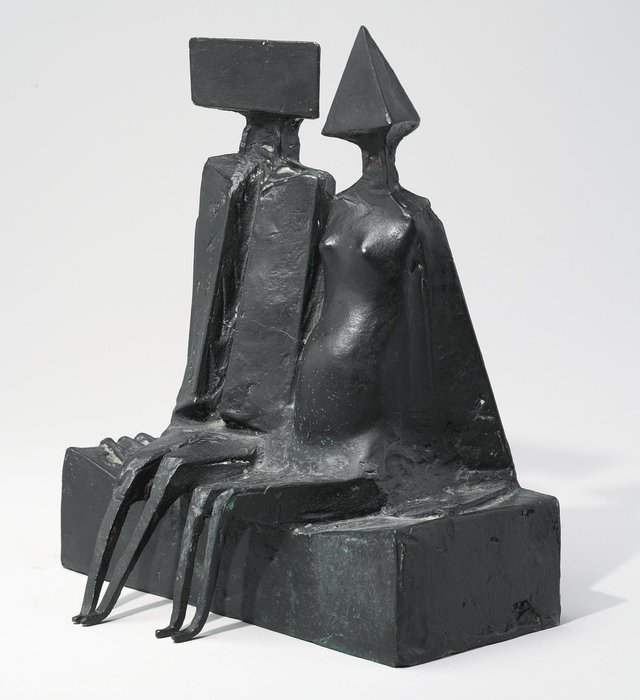
His 1955 work, "Teddy Boy and Girl," serves as a masterful example of this cultural intersection. In this piece, he moved beyond abstract tension to celebrate the rebellious energy of the post-rationing era, immortalizing the stylized, defiant aesthetic of the "teddy boy" subculture. Through these figures, Chadwick proved that modernism could be both intellectually rigorous and socially resonant, capturing the very essence of a generation finding its voice through fashion and attitude.
A Lasting Impression on Modernity
The significance of Lynn Chadwick’s contribution to art history lies in his refusal to separate the mathematical from the emotional. His career was marked by prestigious accolades, most notably winning the International Sculpture Prize at the 1956 Venice Biennale, an achievement that solidified his standing on the global stage. His ability to manipulate heavy metals into shapes that suggest movement and breath allowed him to bridge the gap between the industrial and the human.
Today, the enduring power of his work is reflected in its presence within the world's most esteemed institutions, ensuring that his vision of geometric emotion continues to inspire:
- The Museum of Modern Art (MoMA), New York
- The Tate, London
- The Centre Georges Pompidou, Paris
As we look back upon his oeuvre, we see more than just bronze and steel; we see a lifelong meditation on the balance between strength and fragility, between the rigid lines of architecture and the fluid complexities of the human soul. Lynn Chadwick remains a titan of British modernism, an artist who taught us that even within the most starkly geometric forms, a heartbeat can be found.


 معاينة الحجم الواقعي
 التبديل إلى المطبوعات
 إرسال
إرسال مشاركة
 عرض التفاصيل
 دليل الأعمال الفنية للطلاب

 تحميل
تحميل
 قطع مشابهة
 الأشعة السينية
 عرض شرائح متتابع
 الإحصائيات
 اقرأ المزيد


