Law and Grace: A Masterpiece of the Northern Renaissance
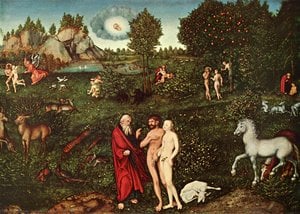
Lucas Cranach the Elder's "Law and Grace," painted in 1529, stands as a pivotal work within the Northern Renaissance artistic landscape. This oil on panel artwork, measuring 72 x 88 cm, is more than just a visually striking piece; it’s a profound theological statement reflecting the burgeoning Protestant Reformation.
Composition and Symbolism
The painting's composition is meticulously structured to convey its complex message. The foreground features two men seated on rocks – one holding a book and another reading from it, symbolizing the study of scripture. Behind them, various figures engage in different actions: a person stands near a tree, another kneels, all contributing to a bustling narrative scene. Central to the work are religious figures like Jesus and Mary, alongside other characters likely representing biblical stories or allegorical representations of faith and salvation.
- The Law (Left Side): Depicts scenes emphasizing human fallibility and the consequences of sin. The presence of Death and demons tormenting a figure highlights the futility of relying on good works for redemption. Moses receiving the tablets represents the Old Testament law.
- Grace (Right Side): Showcases the promise of salvation through faith in Jesus Christ. John the Baptist points towards Christ on the cross, symbolizing sacrifice and forgiveness. The vibrant tree signifies life and renewal offered through grace.
- Central Tree: Acts as a visual divider between Law and Grace, its contrasting states (dead vs. alive) further emphasizing the theological distinction.
Historical Context: Lutheran Merkbilder
"Law and Grace" is a prime example of what are known as "Lutheran Merkbilder"—simple, didactic illustrations designed to convey Christian doctrine in an accessible way. Created during a period of intense religious upheaval—the Protestant Reformation—the painting directly reflects Cranach's close association with Martin Luther and his role as a visual propagandist for the burgeoning Protestant cause. The artwork served as a powerful tool for disseminating Lutheran beliefs amidst challenges to Catholic teachings.
Artistic Significance and Technique
Lucas Cranach the Elder (1472-1553) was a leading figure of the Northern Renaissance, renowned for his portraits, landscapes, and religious paintings. His workshop produced numerous woodcuts and engravings, establishing him as a master of an ornate and idyllic style. "Law and Grace" showcases Cranach's skill in combining complex narratives with human interactions, demonstrating his ability to translate theological concepts into compelling visual imagery. The use of oil on panel allowed for rich detail and vibrant colors, characteristic of the Northern Renaissance aesthetic.
Emotional Impact and Relevance
“Law and Grace” evokes a sense of contemplation and spiritual reflection. It prompts viewers to consider fundamental questions about salvation, faith, and humanity's relationship with the divine. The painting’s enduring appeal lies in its ability to communicate profound theological ideas through accessible imagery, making it a significant work for art enthusiasts and those interested in the history of religious art.



 معاينة الحجم الحقيقي
 اشترِ لوحة مرسومة يدويًا
 مشاركة
 مشاركة
 التفاصيل

 تحميل الملف
 قطع مشابهة
 الأشعة السينية
 عرض شرائح


 عرض المزيد






































 خيار الزجاج متاح فقط للمقاسات التي تقل عن 110 سم