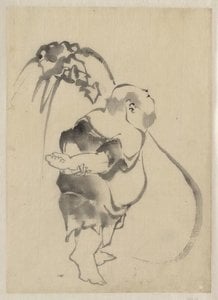
The Tiger’s Brush: The Life and Legacy of Kishi Ganku
Kishi Ganku, born either in 1749 or 1756 – records differ on the precise date – emerged as a pivotal figure in late Edo period Japanese painting. Though his origins lay in Kanazawa, it was Kyoto that would become the crucible of his artistic development and the birthplace of the Kishi school. Initially known as Kishi Saeki, Ganku’s early life remains somewhat shrouded in mystery, but his trajectory reveals a relentless pursuit of mastery across diverse styles before forging his own distinctive path. He wasn't merely a painter; he was a synthesist, absorbing influences from established schools and ultimately transcending them to create a uniquely dynamic aesthetic.
Early Studies and the Embrace of Eclecticism
Ganku’s artistic education was far from conventional. He didn’t confine himself to a single tradition but embarked on a journey of stylistic exploration that would profoundly shape his future work. His initial training included the formal techniques of Kanō painting, known for its decorative elegance and association with the ruling class. However, Ganku soon gravitated towards the more naturalistic approach exemplified by Shen Nanpin, a Chinese painter who visited Japan in the 18th century and whose bird-and-flower compositions captivated Japanese artists. This fascination with Nanpin’s realism marked an early turning point, pushing Ganku beyond purely decorative concerns toward a closer observation of nature.
But his intellectual curiosity didn't stop there. He also immersed himself in the principles of the Maruyama school, celebrated for its meticulous detail and lifelike depictions of flora and fauna. This period was crucial; it instilled in him a deep appreciation for accurate representation and a commitment to capturing the essence of his subjects. He further studied under masters of the Shijō school, absorbing elements of *nanga* painting – a style emphasizing literati culture and expressive brushwork. It was this remarkable confluence of influences—Kanō elegance, Nanpin’s realism, Maruyama precision, and Shijō expressiveness—that laid the foundation for Ganku's unique artistic voice.
The Rise to Prominence and Founding of the Kishi School
By the late 18th century, Ganku had established himself in Kyoto and begun attracting a devoted following. His talent didn’t go unnoticed by the imperial court; he secured a position as a retainer under Prince Arisugawa, a patronage that significantly elevated his status and provided him with opportunities to showcase his skills. This association not only brought financial stability but also access to a wider network of influential art collectors and connoisseurs.
It was around this time that Ganku formally founded the Kishi school, a testament to his growing confidence in his own artistic vision. The school quickly gained recognition for its distinctive style—characterized by bold brushwork, dynamic compositions, and an unparalleled focus on capturing the raw energy of nature. While he painted landscapes, portraits, and flowers with considerable skill, it was his depictions of tigers that truly cemented his reputation. These weren’t simply representations of animals; they were powerful symbols of courage, strength, and untamed spirit.
The Symbolism of Tigers and a Legacy of Students
Ganku's tigers are arguably his most iconic works. They exude an almost palpable sense of power and vitality, their fur rendered with vigorous brushstrokes that convey both physical presence and inner ferocity. The tiger held a complex symbolic meaning in Japanese culture—representing protection against evil spirits, courage, and the forces of nature. Ganku’s tigers weren't merely aesthetic objects; they were imbued with these cultural associations, appealing to patrons seeking not just beauty but also spiritual resonance.
Ganku was a dedicated teacher, and his school flourished under his guidance. He nurtured a talented circle of students, including his son Gantai, his son-in-law Ganryou, adopted son Renzan, and prominent artists like Yokoyama Kazan, Shirai Kayou, and Kawamura Bumpou. He received the honorary title of Echizen no kami (governor of Echizen) towards the end of his life, a further acknowledgement of his artistic achievements and social standing.
Historical Significance and Enduring Influence
Kishi Ganku died in Kyoto on January 19, 1839, leaving behind a rich legacy that continues to inspire artists today. He bridged the gap between traditional Japanese painting styles and a more dynamic, expressive approach rooted in direct observation of nature. The Kishi school continued to thrive for several generations after his death, though it eventually faded from prominence with the advent of modern art movements. However, Ganku’s influence can still be seen in contemporary Japanese painting, particularly in works that emphasize bold brushwork and a powerful connection to the natural world.
His paintings remain highly sought-after by collectors worldwide, not only for their aesthetic beauty but also for their historical significance as exemplars of late Edo period artistry. Ganku’s story is one of relentless exploration, artistic synthesis, and the enduring power of a single brush to capture the essence of life itself.



 معاينة الحجم الحقيقي
 التحويل إلى المطبوعات
 مشاركة
 مشاركة
 التفاصيل
 الدليل

 تحميل الملف
 قطع مشابهة
 الأشعة السينية
 عرض شرائح
 الإحصائيات


 عرض المزيد