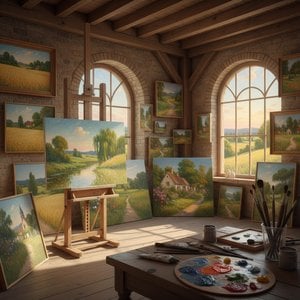
The Soul of the Baltic: The Life and Art of Karl Lorenz Rettich
In the quiet, salt-misted landscapes of the German coast, the name Karl Lorenz Rettich evokes a profound sense of serenity and atmospheric depth. Born in 1841 in Rosenhagen, near the Bay of Lübeck, Rettich was a child of the Mecklenburg countryside, raised amidst the sprawling manor estates of his family. This early immersion in the unspoiled beauty of the Baltic region did more than merely provide scenery; it planted the seeds of an artistic obsession with light, water, and the ephemeral moods of nature that would define his entire career. While his father initially steered him toward a more pragmatic path—enrolling him to study law at Munich University in 1859—the call of the canvas proved irresistible, leading him to abandon the courtroom for the studio.
Rettich’s artistic evolution was shaped by a series of prestigious encounters with the masters of his era. His transition from law student to dedicated painter began under the tutelage of Adolf Heinrich Lier in Munich, a mentor who helped him navigate the delicate balance between realism and romanticism. Seeking further refinement, Rettich journeyed to the legendary Düsseldorf School of Painting, where he studied alongside luminaries such as Albert Flamm and Theodor Hagen. This period was transformative, as he absorbed the nuances of tonal painting—a technique that emphasized the subtle interplay of light and shadow to create a sense of atmosphere. His thirst for knowledge later led him to Weimar, where he refined his landscape techniques under the guidance of the visionary Arnold Böcklin, an experience that undoubtedly deepened the emotional resonance and symbolic weight of his compositions.
A Journey Through Light and Terrain
The breadth of Rettich’s oeuvre is a testament to his restless, wandering spirit. He was not merely a painter of local vistas but a chronicler of diverse European terrains. His extensive expeditions through the rugged fjords of Norway and the sweeping landscapes of Sweden allowed him to experiment with grander scales and more dramatic geological forms. Similarly, his travels to Italy introduced a warmth and sun-drenched clarity to his palette, providing a striking contrast to the cool, misty tones of his beloved Baltic scenes. These journeys were not merely for sightseeing; they were essential laboratory sessions where he tested the limits of color and light to capture the very essence of the environments he encountered.
As his career matured, Rettich found a profound sense of homecoming in the coastal communities of Graal-Müritz and Ahrenshoop. It was here that his relationship with the Baltic Sea reached its zenith. His works from this period are characterized by an intimate understanding of the sea's temperament—the rhythmic pulse of waves, the shifting textures of sand, and the way the low northern sun pierces through heavy maritime clouds. He possessed a rare ability to render the "atmospheric" not just as weather, but as a palpable presence that envelops the viewer, inviting them into a state of quiet contemplation.
Legacy and Artistic Distinction
Rettich’s achievements extended far beyond the borders of Germany, earning him international acclaim during his lifetime. His talent was recognized on prestigious global stages, receiving awards in London (1874), Melbourne (1876), and Munich (1876). These accolades solidified his status as a significant figure within the German Art Cooperative and earned him the esteemed title of professor, appointed by Frederick Francis IV, Grand Duke of Mecklenburg-Schwerin. Even in his later years, he remained a prolific creator, sustaining himself through the sale of postcards that captured the quintessential beauty of the landscape, ensuring his vision reached a wide audience.
The historical significance of Karl Lorenz Rettich lies in his ability to bridge the gap between the structured traditions of the Düsseldorf School and the emotive, atmospheric sensibilities of late nineteenth-century landscape painting. He remains a master of the "painterly" moment—that fleeting second when light hits the water just so, or when a mist begins to lift from a coastal forest. To look upon a Rettich painting is to experience more than a mere depiction of nature; it is to participate in a timeless dialogue with the elements, preserved forever through his masterful use of tone, texture, and light.



 معاينة الحجم الحقيقي
 اشترِ لوحة مرسومة يدويًا
 مشاركة
 مشاركة
 التفاصيل

 تحميل الملف
 قطع مشابهة
 الأشعة السينية
 عرض شرائح


 عرض المزيد






































 خيار الزجاج متاح فقط للمقاسات التي تقل عن 110 سم