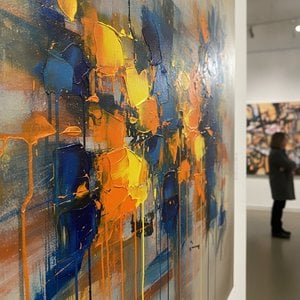
A Symphony of Spontaneity: The Primal Energy of Karel Appel
In the landscape of post-war European modernism, few voices resonate with as much raw, unbridled vitality as that of Karel Appel. His 1960 work, Untitled, serves as a breathtaking manifesto of the COBRA movement, an avant-garde collective that sought to strip away the suffocating layers of academic tradition in favor of something far more primal. To encounter this piece is to witness a deliberate rebellion; it is not merely a composition of pigment on paper, but an explosion of instinctual expression. The artwork captures a moment where the artist’s hand moves with the freedom of a child, yet carries the profound weight of a man navigating a world recovering from the shadows of conflict. Through its vibrant palette and gestural urgency, the work invites the viewer into a realm where emotion dictates form, and where the boundaries between the creator and the canvas dissolve into pure, rhythmic motion.
The visual language of this masterpiece is defined by its biomorphic forms—organic, rounded shapes that seem to pulse with an internal life force. There is no rigid geometry here, nor any attempt at traditional perspective; instead, Appel utilizes an asymmetrical arrangement where colors and shapes overlap in a dance of beautiful chaos. The palette is nothing short of celebratory, dominated by sun-drenched yellows, deep oceanic blues, and fiery reds, all anchored by bold strokes of black and punctuated by flashes of orange and white. These colors are not merely decorative choices but are deeply symbolic; the yellow radiates an infectious optimism, while the blue offers a moment of contemplative stillness amidst the surrounding energy. This interplay of hues creates a complex textural landscape, where the visible layering of the printmaking process suggests a tactile depth that draws the eye into a continuous, wandering exploration.
Historical Resonance and Interior Inspiration
To understand the soul of this work, one must look to the historical heartbeat of the COBRA movement. Born from a desire to break free from the constraints of Surrealism and Cubism, Appel and his contemporaries looked toward the "primitive"—finding profound inspiration in African masks, tribal art, and the uninhibably honest drawings of children. This 1960 print embodies that search for authenticity, rejecting meticulous representation in favor of intuition and gesture. The technique, likely a screenprint or lithograph, allows for a fascinating tension between the flatness of the medium and the perceived movement of the brushstrokes. Each layer of ink contributes to a sense of immediacy, as if the artist’s energetic movements were captured in mid-motion, frozen forever in a state of becoming.
For the discerning collector or interior designer, this artwork offers more than just visual interest; it provides a transformative emotional atmosphere. Its lack of a singular focal point allows it to integrate seamlessly into sophisticated modern environments, acting as a dynamic anchor in a room. In a minimalist setting, its bold colors can provide a much-needed burst of life and character, while in a more eclectic space, it serves as a testament to the enduring power of the avant-garde. Owning a high-quality reproduction of this piece is an invitation to live alongside a fragment of art history—a piece that celebrates the joy of existence, the beauty of imperfection, and the eternal, restless spirit of human creativity.
الأسئلة والأجوبة
كيف يمكنني معاينة نسخة من "Untitled" للفنان كاريل أبل؟
تتيح لك صفحة معاينة الخاصة بـ "Untitled" معاينة العمل الفني قبل الطلب.
هل بقيت "Untitled" في الموطن الأصلي لفنانها؟
لا - العمل الفني محفوظ خارج البلاد. بلد ميلاد الفنان هو هولندا، بينما يقع المتحف الذي يحتفظ بالعمل الأصلي في المملكة المتحدة.
هل يمكنني مشاهدة "Untitled" كعرض شرائح بملء الشاشة؟
يمكن عرض "Untitled" للفنان كاريل أبل كعرض شرائح في صفحة عرض متتابع الخاصة بالعمل الفني.
هل يستخدم "Untitled" للفنان كاريل أبل تباينات قوية أم تناغمات ناعمة؟
تجمع التكوينات اللونية في "Untitled" للفنان كاريل أبل بين تباين Statement وتناغم Balanced Harmony.
ما هي الاستخدامات الموصى بها لنسخة مطبوعة من "Untitled" للفنان كاريل أبل؟
الاستخدام الموصى به لنسخة مطبوعة من "Untitled" هو Accent.
كيف ترتبط ألوان "Untitled" للفنان كاريل أبل بالعاطفة التي تعبر عنها؟
في "Untitled"، ترافق ألوان Neutrals شعوراً بـ Joyful.
أين يمكنني مشاهدة العمل الأصلي "Untitled" للفنان كاريل أبل؟
تُحفظ النسخة الأصلية من "Untitled" للفنان كاريل أبل في تيت بريطانيا, لندن, المملكة المتحدة. وتتيح لك النسخة المطبوعة عرض هذا العمل الفني في منزلك.
ما الذي تشترك فيه "Untitled" مع بقية أعمال كاريل أبل؟
ينتمي العمل "Untitled" إلى أعمال كاريل أبل ضمن مدرسة COBRA Expressionism، والتي تشمل موضوعاتها المسجلة expressionist roots, organic forms exploration, bold color dialogue, rejection formal norms, central cobra vision.



 معاينة الحجم الواقعي
 اطلب نسخة مرسومة يدويًا
 إرسال
إرسال مشاركة
 عرض التفاصيل
 دليل الأعمال الفنية للطلاب

 تحميل
تحميل
 قطع مشابهة
 الأشعة السينية
 عرض شرائح متتابع
 الإحصائيات


 اقرأ المزيد






































 خيار الزجاج متاح فقط للمقاسات التي تقل عن 110 سم


![Abstract Composition [triptych] — Vaclav Vytlacil, Abstract Expressionism](/media/artworks/images-thumb/08/3c/083c0675045645fd42d4e6c6d63f1ced.jpg)