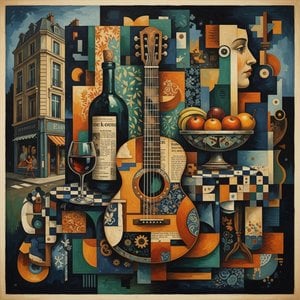
Guitar on a Table: A Synthesis of Form and Music
Juan Gris's "Guitar on a Table," painted in 1915, stands as a quintessential example of Synthetic Cubism. This captivating artwork, measuring 73 x 92 cm and housed at the Kröller-Müller Museum in Otterlo, Netherlands, transcends a simple depiction of an object; it's an exploration of form, perspective, and the interplay between reality and abstraction. Gris masterfully deconstructs and reassembles familiar elements—a guitar, books, and table surfaces—into a harmonious composition characterized by geometric shapes and a carefully considered color palette.
The Artist: Juan Gris – A Pioneer of Cubism
- Born: March 23, 1887, Madrid, Spain
- Died: May 11, 1927
José Victoriano González-Pérez, known as Juan Gris, was a pivotal figure in the development of Cubism. After studying engineering and demonstrating early artistic talent through drawings for periodicals, he moved to Paris in 1906, immersing himself in the vibrant art scene. There, he befriended Pablo Picasso and Georges Braque, becoming an integral part of the Cubist movement. Gris’s style evolved over time, but his dedication to Cubism remained constant, marked by a unique approach that emphasized composition and color.
Analyzing the Composition: Synthetic Cubism in Action
"Guitar on a Table" exemplifies Synthetic Cubism, a phase characterized by simplified forms, overlapping planes, and a focus on overall composition rather than deconstruction. The central motif is a guitar, rendered with five strings instead of the usual six—a deliberate choice by Gris to move away from realistic representation and emphasize the abstract nature of his artistic vision. This intentional alteration extends to the musical staff, depicted with fewer lines than typical. The surrounding elements – books and other objects – create a sense of cluttered harmony. The color palette is rich and nuanced, featuring shades of blue, brown, green, and speckled patterns that add texture and depth. Gris skillfully interweaves delineations reminiscent of guitar strings and the instrument’s curves with elements of the table surface, showcasing his mastery in fragmenting reality while maintaining a sense of visual coherence.
Artistic Significance and Symbolism
Gris's work, including "Guitar on a Table," significantly contributed to the evolution of Cubism. His approach to Synthetic Cubism, with its emphasis on composition and color, enriched the movement’s diversity. The recurring motif of the Spanish guitar reflects Gris's cultural heritage and his artistic fascination with the shapes of musical instruments. Beyond being a representation of an object, this painting is an exploration of form and perspective, inviting viewers to interpret the fragmented reality portrayed. The deliberate simplification and abstraction challenge conventional notions of representation, prompting contemplation on the nature of perception and the artist’s role in shaping our understanding of the world.



 معاينة الحجم الحقيقي
 التحويل إلى المطبوعات
 مشاركة
 مشاركة
 التفاصيل

 تحميل الملف
 قطع مشابهة
 الأشعة السينية
 عرض شرائح
 الإحصائيات


 عرض المزيد






































 خيار الزجاج متاح فقط للمقاسات التي تقل عن 110 سم