The Geometry of Perception: Exploring Juan Gris's Synthetic Cubism
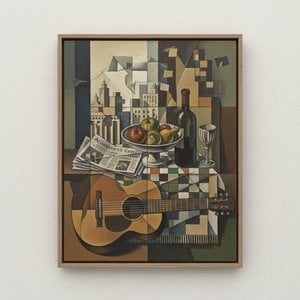
To stand before Bottle and Glass on a Table is not merely to observe an arrangement of objects; it is to witness a profound intellectual exercise rendered in vibrant pigment. Created in 1914, this canvas by Juan Gris stands as a luminous testament to the revolutionary spirit of Synthetic Cubism. The work transcends simple still life, inviting the viewer into a meticulously constructed reality where form and function are deconstructed and reassembled according to an internal logic. It is a dialogue between recognizable subject matter—a bottle and glass resting upon a surface—and the exhilarating abstraction that defines early 20th-century modernism.
A Masterclass in Fragmented Form
Gris’s technique here is nothing short of brilliant; it embodies the core tenets of Synthetic Cubism. Unlike earlier explorations of fragmentation, this style builds up reality using distinct, overlapping planes and geometric shapes. The eye is immediately drawn to the central, commanding blue triangle, a focal point that anchors the entire composition. This primary shape is not isolated but interacts dynamically with surrounding elements—smaller triangles jutting out towards the upper right, and two serene circles positioned near the left and middle-left areas. These forms do not merely decorate; they construct. They suggest depth, overlap, and multiple viewpoints simultaneously, forcing the viewer's perception to become an active participant in the artwork’s making.
Historical Echoes and Intellectual Depth
The context of 1914 is crucial to understanding this piece. At a time when art was rapidly shedding its academic constraints, Gris utilized geometry as both a tool and a philosophy. Influenced by the groundbreaking work of Picasso and Braque, he moved beyond mere imitation. His approach suggests that reality itself can be understood through its underlying mathematical structure. Owning a reproduction of Bottle and Glass on a Table is therefore acquiring more than just decoration; it is possessing a tangible piece of art history—a record of the moment modern art found its rigorous, beautiful language.
Emotional Resonance for the Modern Space
For the collector or designer seeking to infuse a space with intellectual vigor and sophisticated color, this painting offers unparalleled depth. The vibrant interplay between the cool blues, the structured geometry, and the implied solidity of the objects creates an atmosphere that is both energetic and deeply contemplative. It speaks to a modern sensibility—one that appreciates structure, clarity, and the beauty found in deconstruction. Imagine this piece anchoring a drawing-room or study; its controlled chaos provides a stimulating counterpoint to softer furnishings, elevating any interior with its vibrant, thoughtful presence.



 معاينة الحجم الحقيقي
 Switch to Print
 مشاركة
 مشاركة
 التفاصيل

 تحميل الملف
 قطع مشابهة
 الأشعة السينية
 عرض شرائح
 Stats
Stats


 عرض المزيد






































 خيار الزجاج متاح فقط للمقاسات التي تقل عن 110 سم