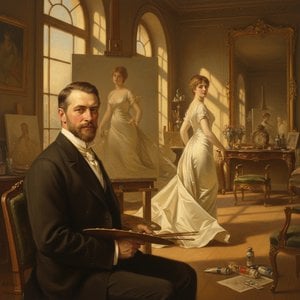
A Portrait Steeped in Shadow and Grace
In the quietude of 1889, John Singer Sargent captured more than just a likeness; he bottled an atmosphere. Madame Helleu stands as a profound testament to the artist's ability to transcend mere representation, moving into the realm of psychological depth. As one gazes upon this masterpiece, they are not simply looking at a woman seated by a window, but rather witnessing a moment of profound introspection caught in the amber of the Belle Époque. The painting presents a subject bathed in muted, somber tones, where the interplay of light and shadow creates a pervasive sense of melancholy and quiet dignity. It is a work that does not shout for attention but instead commands it through a whispered, haunting elegance.
Sargent’s technical prowess is on full display through his masterful command of texture and light. While his roots lay in the rigorous traditions of realism, this portrait breathes with the subtle, flickering energy of Impressionism. He employs a palette dominated by cool blues and deep greens, a deliberate choice that anchors the painting in a mood of contemplative solitude. The way the light catches the delicate folds of Madame Hineu’s white dress and reflects softly against the windowpane reveals an artist obsessed with the palpable physicality of his subject. His brushstrokes are both delicate and decisive, layering pigment to build form that feels as though it could be touched, making the artwork a sensory experience for any observer.
The Intersection of Elegance and Isolation
Beyond the technical brilliance lies a narrative of social standing and internal solitude. The composition places Madame Helleu at a table, positioned before a window that serves as both a source of light and a symbolic barrier between her private world and the external reality. This placement is crucial; it evokes a feeling of isolation, suggesting a woman caught in a moment of deep thought, perhaps reflecting on the rigid expectations of Victorian society. The subject herself represents the height of aristocratic grace, yet Sargent refuses to present her as a mere decorative object. Instead, he imbues her with a soul, using the heavy shadows and the stillness of her clasped hands to suggest a complex inner life.
For the discerning collector or interior designer, this piece offers an unparalleled opportunity to introduce a sense of historical weight and emotional sophistication into a space. The subdued color palette and the masterful use of chiaroscuro allow it to integrate seamlessly into refined, classic interiors, providing a focal point that invites long periods of contemplation. A high-quality reproduction of this work does not merely decorate a wall; it brings into a home the very essence of an era defined by luxury, transition, and the enduring beauty of the human spirit.



 معاينة الحجم الحقيقي
 اشترِ نسخة مطبوعة
 مشاركة
 مشاركة
 التفاصيل

 تحميل الملف
 قطع مشابهة
 الأشعة السينية
 عرض شرائح


 عرض المزيد






































 خيار الزجاج متاح فقط للمقاسات التي تقل عن 110 سم