A Moment Frozen in Time: John Constable’s Study of Hollyhocks
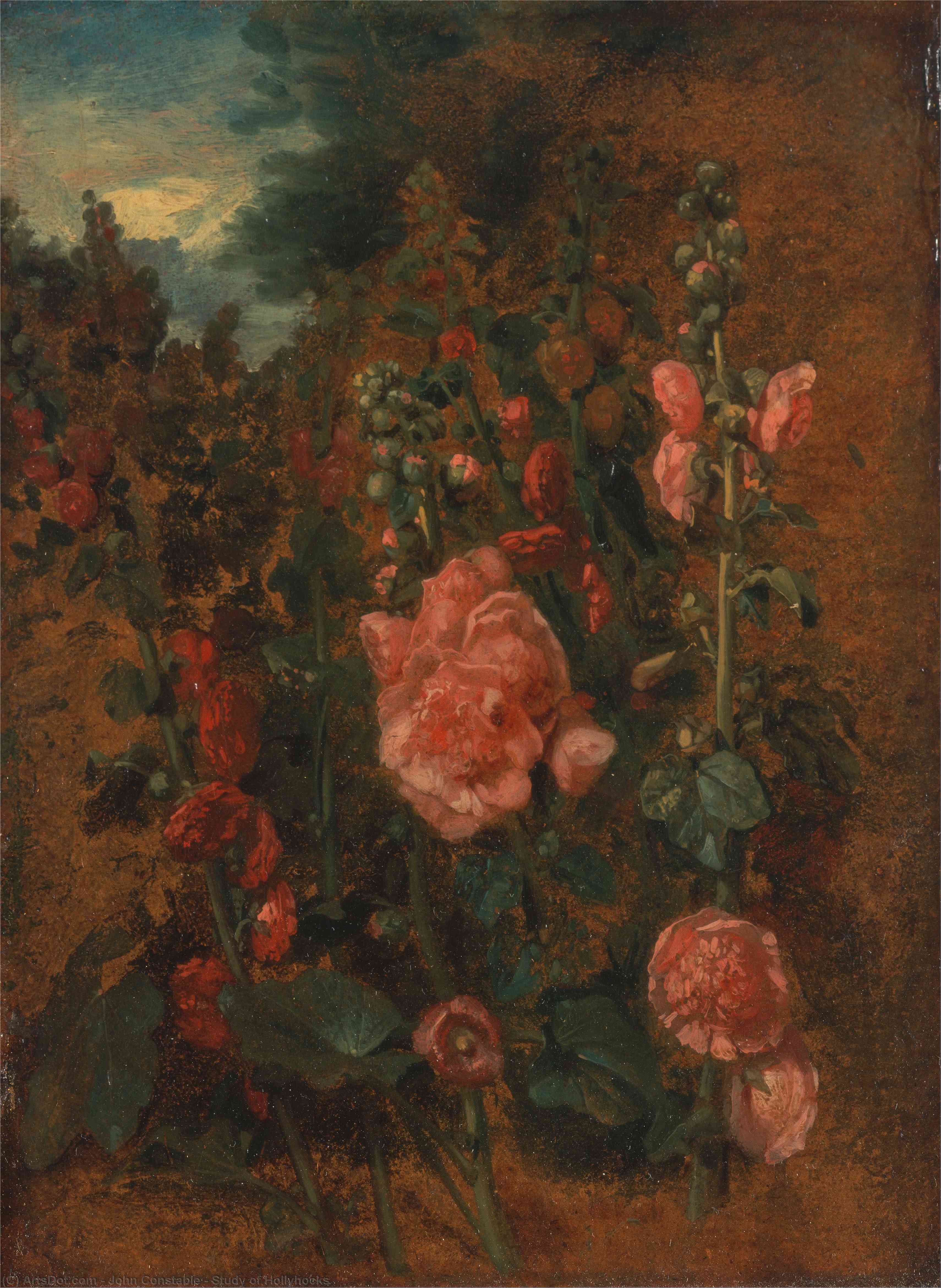
John Constable's Study of Hollyhocks, painted in 1826, isn’t merely a depiction of flowers; it’s a profound meditation on the beauty and transience of nature, rendered with an almost palpable sense of immediacy. This oil painting, currently residing within the esteemed Yale Center for British Art in New Haven, Connecticut, offers a rare glimpse into Constable's intensely personal approach to landscape art – a departure from the grand historical narratives favored by his contemporaries and a testament to his unwavering dedication to capturing the essence of the English countryside as he truly *saw* it. The painting’s quiet intimacy, achieved through a masterful manipulation of light, color, and composition, invites the viewer into a serene, sun-drenched corner of Constable's beloved Dedham Vale.
Constable’s genius lay in his ability to imbue ordinary subjects – humble hollyhocks, a solitary bird – with extraordinary emotional resonance. He wasn’t interested in idealized representations; instead, he sought to portray the world as it was, with its imperfections and fleeting moments of beauty. The painting's palette is remarkably restrained, dominated by soft greens, pinks, and blues, creating a harmonious blend that feels both naturalistic and deeply evocative. Notice how Constable uses subtle variations in tone – the delicate blush of the hollyhock petals, the hazy light filtering through the branches – to create a sense of depth and atmosphere. The composition itself is carefully considered, guiding the eye through the scene with a gentle rhythm, drawing us into this intimate tableau.
The Painter’s Process: Observation and Emotion
Unlike many artists of his time who relied on sketches and preparatory drawings, Constable often worked directly onto the canvas, allowing for an intuitive and spontaneous approach. This is evident in Study of Hollyhocks, where brushstrokes are loose and expressive, conveying a sense of movement and vitality. He employed a technique known as “impasto,” applying thick layers of paint to create texture and highlight certain areas – particularly the petals of the hollyhocks themselves. This tactile quality invites us to almost feel the velvety softness of the flowers.
Constable’s dedication to capturing the nuances of light is truly remarkable. He meticulously observed how sunlight interacted with the foliage, creating a dappled effect that adds depth and realism to the scene. The bird perched on one of the branches isn't simply an accessory; it’s a vital element of the composition, suggesting life and movement within this otherwise still landscape. It’s a small detail that elevates the painting beyond a mere botanical study, transforming it into a vibrant snapshot of rural England.
A Window into Constable’s World
To fully appreciate Study of Hollyhocks, it's helpful to understand Constable’s broader artistic vision. He was deeply rooted in the landscape of Suffolk and Essex, finding inspiration in the everyday details of rural life – the meandering rivers, the thatched cottages, the wildflowers that dotted the fields. His paintings weren’t intended as grand statements; they were intimate reflections on his personal connection with nature. He famously declared, “I should paint my own places best,” a sentiment perfectly encapsulated in this delicate and luminous work.
Beyond its aesthetic beauty, Study of Hollyhocks offers a valuable insight into Constable’s artistic philosophy – a commitment to truthfulness, observation, and emotional expression. It's a painting that rewards repeated viewing, revealing new details and nuances with each encounter. Reproductions by WahooArt offer an exceptional opportunity to bring this masterpiece into your home or office, allowing you to experience the magic of Constable’s vision firsthand.
Additional Context & Related Works
- Yale Center for British Art Collection: This painting is a cornerstone of the Yale Center's impressive collection of British art, showcasing its commitment to preserving and exhibiting masterpieces from the 18th and 19th centuries.
- East Bergholt: Another significant work by Constable, also housed at the Yale Center for British Art, demonstrates his mastery of capturing the atmospheric effects of light and shadow in a rural landscape.
- Mary Freer: A portrait painting by Constable, offering a glimpse into his artistic versatility and his ability to capture human emotion.
- Flatford Lock: A paper work preserved at the Yale Center for British Art, providing insight into Constable’s working methods and his fascination with water landscapes.
Explore more of John Constable's captivating works through WahooArt.com – Painting by 'John Constable' | John Constable:Study of Hollyhocks



 معاينة الحجم الحقيقي
 اشترِ لوحة مرسومة يدويًا
 مشاركة
 مشاركة
 التفاصيل

 تحميل الملف
 قطع مشابهة
 الأشعة السينية
 عرض شرائح


 عرض المزيد






































 خيار الزجاج متاح فقط للمقاسات التي تقل عن 110 سم