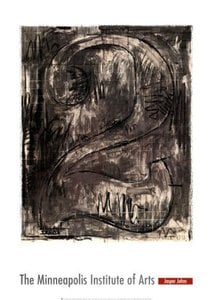
Jan Lebenstein: A Visionary of Axial Forms
Born in Brest Litovsk, Poland, in 1930 and tragically passing away in Krakow in 1999, Jan Lebenstein remains a profoundly enigmatic figure within the landscape of 20th-century art. His work, characterized by its arresting simplicity and deeply felt existentialism, defies easy categorization, oscillating between abstraction and figuration while consistently exploring themes of identity, connection, and the human condition. Lebenstein’s artistic journey was shaped by a complex interplay of influences – from the early austerity of Polish Expressionism to the subtle nuances of Utrillo's interiors and the stark geometries of Wols – culminating in his signature “Axial Figures,” a series that continues to captivate and provoke contemplation.
His formal training at Warsaw’s Academy of Fine Arts under Artur Nacht-Samborski provided a foundational understanding of traditional techniques, yet Lebenstein quickly diverged from established norms. He wasn't interested in replicating reality; instead, he sought to distill it into its most essential elements. This pursuit led him to develop his distinctive visual language – vertical compositions dominated by simplified, almost insect-like human figures, often presented within starkly delineated interiors. These “Axial Figures,” as they became known, are not portraits in the conventional sense but rather symbolic representations of the self, imbued with a palpable sense of loneliness and introspection.
The Teatr na Tarczyńskiej and the Birth of Axial Form
Following his studies, Lebenstein found himself deeply involved with the *Teatr na Tarczyńskiej*, an independent theatre collective operating out of Miron Białoszewski’s Warsaw apartment. This unconventional environment fostered a spirit of experimentation and collaboration, providing a crucial space for the development of his artistic ideas. It was during this period that he began to explore what would become his most enduring motif: the “Axial Figures.” These weren't merely sketches; they were carefully considered compositions, imbued with a deliberate sense of balance and geometric precision. The figures themselves – often female – are rendered in simplified forms, their bodies elongated and attenuated, suggesting both vulnerability and resilience.
Early works from this period, such as “Skrzypek / The Fiddler” (c. 1955), demonstrate Lebenstein’s fascination with interiors and the quiet dramas of everyday life. These gouaches are characterized by their muted color palette and symbolic imagery – a lone violinist within a sparsely furnished room, evoking themes of isolation and artistic expression. The influence of Utrillo is particularly evident in these early works, as Lebenstein adopted his predecessor’s penchant for capturing the atmosphere of intimate spaces.
International Recognition and Parisian Exile
In 1959, Lebenstein's work gained international recognition when it was exhibited at the First International Biennale of Young Artists in Paris. This event marked a turning point in his career, attracting the attention of prominent European critics and collectors. The acclaim he received fueled his decision to relocate permanently to France, where he continued to develop his artistic vision for decades.
During his time in Paris, Lebenstein maintained close ties with the Polish émigré community, collaborating with figures such as Konstanty A. Jeleński and Jean Cassou. His work was exhibited throughout Europe, solidifying his reputation as a unique and compelling voice within contemporary art. Despite achieving considerable success, Lebenstein remained committed to his own artistic principles, eschewing commercialism and prioritizing the exploration of profound existential themes.
The Legacy of Axial Figures
Jan Lebenstein’s legacy lies not in grand gestures or overt displays of virtuosity but rather in the quiet intensity of his “Axial Figures.” These enigmatic compositions continue to resonate with viewers today, prompting questions about identity, connection, and the human condition. His work stands as a testament to the power of simplicity, suggesting that profound meaning can be found within the most pared-down forms. The ongoing interest in Lebenstein’s oeuvre— evidenced by exhibitions like “Jan Lebenstein: Demons” at the Zachęta National Gallery of Art in 2005—demonstrates the enduring relevance and artistic significance of this singular artist.
His influence extends beyond his own creations, inspiring subsequent generations of artists to explore unconventional approaches to representation. The stark beauty and emotional depth of Lebenstein’s “Axial Figures” remain a powerful reminder of the capacity for art to illuminate the complexities of human experience.



 معاينة الحجم الحقيقي
 التحويل إلى المطبوعات
 مشاركة
 مشاركة
 التفاصيل

 تحميل الملف
 قطع مشابهة
 الأشعة السينية
 عرض شرائح
 الإحصائيات

 عرض المزيد