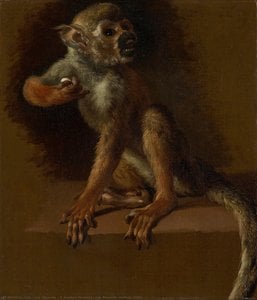
A Moment of Stillness: Exploring the Haunting Beauty of "Dead Partridge"
Jan Baptist Weenix’s “Dead Partridge,” painted around 1650-1652 and now residing within the esteemed Mauritshuis in The Hague, is more than just a depiction of a fallen bird; it's a meticulously crafted meditation on mortality, observation, and the subtle poetry of the natural world. Born in Amsterdam during a period of burgeoning artistic innovation, Weenix emerged as a pivotal figure in Dutch Golden Age painting, particularly renowned for his pioneering approach to Italianate landscapes infused with human presence – a technique that profoundly influenced generations of artists to come. This particular work, rendered in oil on canvas measuring 50 x 43 cm, exemplifies his mastery of chiaroscuro and his uncanny ability to capture the fleeting essence of life’s transience.
The composition is strikingly simple yet deeply resonant. A single, dead partridge hangs suspended from a nail, its feathers arranged in an almost deliberate, unsettling display against a muted beige background. The bird's posture – feet tied together, plumage spread wide – immediately evokes a sense of vulnerability and finality. Crucially, the scene isn’t presented with overt drama or pathos; instead, Weenix employs a quiet restraint that amplifies the painting’s contemplative mood. This deliberate lack of sentimentality is characteristic of his style, prioritizing precise observation and technical skill over emotional excess.
The Language of Light and Shadow: A Study in Technique
Weenix's genius lies not just in his subject matter but also in his masterful manipulation of light and shadow. The painting’s illumination is carefully controlled, creating a dramatic interplay between dark tones and subtle highlights that imbue the scene with depth and volume. The artist utilizes *chiaroscuro* – the contrasting of strong light and deep shadows – to sculpt the bird's form, drawing the viewer’s eye directly to its lifeless body. Notice how the folds of the feathers are rendered with painstaking detail, each strand appearing almost tangible. The subtle gradations of color—from the rich browns and ochres of the plumage to the cool grays and beiges of the background—further enhance the painting's realism and atmospheric quality.
Furthermore, Weenix’s technique is reminiscent of other prominent Dutch Masters like Willem Kalf and Balthasar van der Ast, both known for their meticulous attention to detail and their ability to capture the textures of everyday objects. The artist’s brushwork is remarkably smooth and controlled, contributing to the painting's overall sense of serenity and composure. The careful rendering of the nail itself—its rough texture and slightly tarnished surface—adds a layer of realism that elevates the work beyond mere representation.
Historical Context and Symbolic Resonance
“Dead Partridge” was painted during the Dutch Golden Age, a period of unprecedented artistic flourishing fueled by economic prosperity and intellectual curiosity. The painting reflects the era’s fascination with still life – a genre that allowed artists to explore themes of mortality, beauty, and the transient nature of earthly possessions. The partridge itself held symbolic significance in 17th-century Dutch culture, often associated with abundance, fertility, and even death—a poignant reminder of the cyclical nature of life and decay. The painting’s setting – a simple, neutral background – further emphasizes the bird's vulnerability and underscores its role as the central focus of attention.
Interestingly, Weenix’s work draws inspiration from Italianate traditions, particularly the depictions of hunting scenes found in the paintings of artists like Jacopo de’ Barbari. This influence is evident in the painting’s composition—the bird's pose and the arrangement of its feathers echo those seen in earlier Italian works. However, Weenix transforms these borrowed elements into something uniquely his own, imbuing them with a distinctly Dutch sensibility.
A Timeless Masterpiece: Reproduction Possibilities
Today, “Dead Partridge” stands as a testament to Jan Baptist Weenix’s artistic vision and technical skill. If you're captivated by this hauntingly beautiful painting, consider commissioning a high-quality reproduction from our skilled artisans. We meticulously recreate the original’s nuances—the subtle gradations of color, the delicate brushwork, and the evocative atmosphere—to ensure that your reproduction captures the essence and beauty of this timeless masterpiece. Explore our available reproductions here.
الأسئلة والأجوبة
ما نوع العمل الفني "Dead Partridge" للفنان جان بابتيست وينيك؟
" Dead Partridge " هي قطعة من نوع WallArt.
هل تُحفظ "Dead Partridge" للفنان جان بابتيست وينيك في الموطن الأصلي للفنان؟
نعم - العمل الفني محفوظ في البلد الأم للفنان. بلد ميلاد جان بابتيست وينيك هو هولندا، بينما يقع المتحف الذي يحتفظ بالنسخة الأصلية من "Dead Partridge" في هولندا.
ما هي الموضوعات التي تظهر في "Dead Partridge" للفنان جان بابتيست وينيك؟
تشمل الموضوعات المتضمنة في "Dead Partridge" للفنان جان بابتيست وينيك كلاً من partridge, hunting, dutch masters, composition, light & shadow, still life, baroque, weenix، وهي مجتمعةً تلخص فحوى العمل الفني.



 معاينة الحجم الواقعي
 اطلب نسخة مرسومة يدويًا
 إرسال
إرسال مشاركة
 عرض التفاصيل
 دليل الأعمال الفنية للطلاب

 تحميل
تحميل
 قطع مشابهة
 الأشعة السينية
 عرض شرائح متتابع
 Q&A
Q&A الإحصائيات


 اقرأ المزيد






































 خيار الزجاج متاح فقط للمقاسات التي تقل عن 110 سم