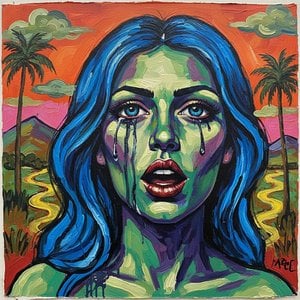
A Symphony of Color: Exploring Henri Matisse’s Untitled (2265)
Henri Matisse, a titan amongst Fauvist painters and arguably the most influential artist of his generation, gifted us with “Untitled (2265),” a deceptively simple portrait that belies its profound depth. Painted sometime between 1906 and 1913—a period marked by Matisse’s fervent embrace of Fauvism—this artwork transcends mere representation; it embodies the very essence of Matisse's revolutionary approach to color and form.
- Subject Matter: The painting depicts a woman seated at a table, her gaze directed inward. This deliberate focus on psychological introspection is characteristic of Matisse’s artistic vision during this era, prioritizing emotion over literal accuracy.
- Style & Technique: Matisse's Fauvist style—derived from the French word for wild beast—rejects academic conventions and champions unrestrained color as its primary expressive tool. Thick brushstrokes dominate the canvas, layering hues of pink and red to create a vibrant tapestry that pulsates with life. The artist skillfully employs flattened planes of color, minimizing tonal variation to heighten visual impact.
The Language of Color: Fauvist Principles Embodied
Matisse’s decision to eschew traditional shading techniques wasn't arbitrary; it stemmed from a belief that color alone could convey emotion and atmosphere more effectively than grayscale realism. He meticulously studied the work of Impressionists like Monet and Cézanne, recognizing their pioneering use of light and color but ultimately rejecting their adherence to naturalistic observation. Instead, Matisse sought to liberate color from its subservient role in depicting reality, transforming it into an independent element capable of generating feeling.
- Color Palette: The dominant hues—pink and red—are deliberately chosen not for their descriptive accuracy but for their psychological associations. Pink evokes tenderness and femininity, while red symbolizes passion and vitality. Matisse’s masterful blending of these colors creates a harmonious yet dynamic visual experience.
- Composition & Texture: Notice the careful arrangement of shapes and forms within the painting. The woman's posture is relaxed yet contemplative, mirroring Matisse’s own desire to capture inner states of mind. Furthermore, the textured surface of the canvas—achieved through thick brushstrokes—adds another layer of sensory richness, inviting viewers to engage with the artwork on a tactile level.
Historical Context & Artistic Significance
“Untitled (2265)” emerged during a pivotal moment in art history—the early 20th century—when artists were actively challenging established norms and experimenting with new artistic languages. Matisse’s Fauvist movement represented a bold reaction against the prevailing stylistic trends of the time, signaling a decisive break from Impressionism and Post-Impressionism.
- Influence: Matisse's work profoundly impacted subsequent generations of artists, inspiring movements such as Expressionism and Surrealism. His unwavering commitment to color and simplification paved the way for innovative approaches to visual representation.
- Legacy: Today, “Untitled (2265)” stands as a testament to Matisse’s artistic genius—a captivating exploration of color, form, and psychological introspection that continues to resonate with audiences worldwide. Its enduring appeal lies in its ability to communicate emotion without resorting to explicit imagery, cementing Matisse's place among the most celebrated artists of all time.
Symbolism & Emotional Resonance
Beyond its formal qualities—color palette, brushstrokes, composition—the painting possesses a subtle symbolic dimension. The woman’s gaze inward suggests a preoccupation with inner thoughts and feelings, reflecting Matisse’s own philosophical concerns about the human condition. The floral wallpaper serves as an additional element of visual richness, subtly reinforcing the theme of beauty and contemplation.
- Mood & Atmosphere: “Untitled (2265)” exudes a serene yet thoughtful mood—a feeling of quiet introspection punctuated by bursts of vibrant color. Matisse skillfully captures this atmosphere through his masterful use of texture and hue, inviting viewers to immerse themselves in the artwork’s emotional landscape.



 معاينة الحجم الواقعي
 التبديل إلى المطبوعات
 إرسال
إرسال مشاركة
 عرض التفاصيل
 دليل الأعمال الفنية للطلاب

 تحميل
تحميل
 قطع مشابهة
 الأشعة السينية
 عرض شرائح متتابع
 الإحصائيات
 اقرأ المزيد






































 خيار الزجاج متاح فقط للمقاسات التي تقل عن 110 سم