A Symphony of Color: Exploring Matisse's "Reclinnning Nude Back"
Henri Matisse’s “Reclinnning Nude Back,” a captivating exploration of form and color, embodies the very essence of Fauvist aesthetics. Painted around 1910-1912, during his pivotal shift towards radical experimentation, this work offers a glimpse into a world where the objective representation of reality is deliberately abandoned in favor of subjective sensation. The painting depicts a woman reclining on her side, a pose frequently employed by Matisse to investigate the expressive potential of color and line. Unlike traditional depictions of the nude that prioritized anatomical accuracy, here, the figure exists primarily as a vibrant arrangement of hues – a testament to Matisse’s desire to capture not what he *saw*, but what he *felt*.
Fauvist Techniques: A Bold Departure
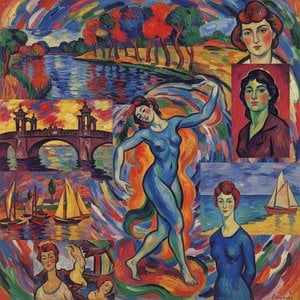
- Color as Subject: The most striking element is undoubtedly the unrestrained use of color. Matisse, along with other Fauvist artists, rejected the muted tones and naturalistic palettes favored by Impressionism. Instead, he employed pure, unmixed colors – intense blues, reds, yellows, and greens – applied with a deliberate lack of blending. This technique creates a dazzling effect, prioritizing visual impact over realistic representation.
- Simplified Forms: The figure’s form is rendered in broad, simplified strokes, further emphasizing the role of color. Details are minimized, allowing the viewer's eye to be drawn directly to the interplay of hues and textures. This simplification aligns with Matisse’s broader artistic philosophy of reducing complex subjects to their most essential elements.
- Impasto Technique: The application of paint is thick – an impasto technique – adding a tactile quality to the surface and intensifying the vibrancy of the colors. This creates a sense of movement and energy, contributing to the painting’s dynamic feel.
Symbolism and the Human Figure
While seemingly straightforward in its depiction, “Reclinnning Nude Back” is rich with symbolic undertones. The reclining pose itself has a long history in Western art, often associated with themes of leisure, vulnerability, and contemplation. Here, however, it’s imbued with Matisse's personal exploration of the female form – a recurring motif throughout his oeuvre. The woman’s relaxed posture suggests a state of blissful repose, inviting the viewer to share in her tranquility. The inclusion of surrounding objects—the chairs, table, vase—adds to the sense of intimacy and domesticity, further emphasizing the painting's focus on human experience.
Historical Context: The Rise of Fauvism
Matisse’s work emerged during a period of profound artistic change in early 20th-century France. Fauvism, meaning "wild beasts," was a short-lived but hugely influential movement that challenged the established conventions of Impressionism and Post-Impressionism. Artists like Matisse, André Derain, and Maurice de Vlaminck sought to liberate color from its descriptive function, using it instead as an expressive tool. “Reclinnning Nude Back” stands as a prime example of this revolutionary approach, foreshadowing the development of Abstract Expressionism in later decades. It represents a pivotal moment in art history – a bold assertion of artistic freedom and a testament to the power of color to evoke emotion and transform perception.



 معاينة الحجم الحقيقي
 اشترِ لوحة مرسومة يدويًا
 مشاركة
 مشاركة
 التفاصيل
 الدليل

 تحميل الملف
 قطع مشابهة
 الأشعة السينية
 عرض شرائح
 الإحصائيات

 عرض المزيد






































 خيار الزجاج متاح فقط للمقاسات التي تقل عن 110 سم