A Window into Renaissance Thought: The Soul of Erasmus
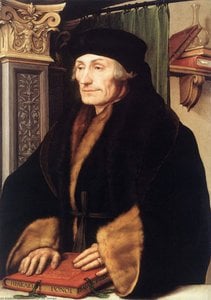
In the quiet, focused atmosphere of Hans Holbein the Younger’s 1523 masterpiece, we encounter more than just a likeness; we enter the very mind of the Northern Renaissance. The Portrait of Erasmus of Rotterdam is a profound meditation on humanism, capturing the essence of a man whose intellect would irrevocently reshape European theology and philosophy. As you gaze upon this oil on panel, you are not merely observing a scholar at work, but witnessing the birth of modern critical thought. Holbein does not rely on grand gestures or opulent surroundings to command attention; instead, he utilizes a masterful intimacy that draws the viewer into the private, contemplative world of one of history's most influential thinkers.
The subject, Desiderius Erasmus, sits as a beacon of intellectual fervor. Captured in a moment of intense concentration, his head is turned slightly, eyes perhaps tracing the lines of a text or lost in the profound weight of his own reflections. There is a palpable sense of movement in his hands—the delicate act of writing upon parchment that suggests the ongoing, restless nature of scholarly pursuit. This is not a static monument to a dead man, but a living, breathing portrait of a mind in motion, making it an extraordinary piece for any collection seeking to evoke depth, wisdom, and the timeless pursuit of knowledge.
The Mastery of Holbein: Precision and Light
To behold a Holbein is to witness the pinnacle of Northern Renaissance technique. The artist’s ability to manipulate oil paint on a small scale achieves an astonishing level of realism that feels almost tactile. Every subtle nuance of Erasmus’s weathered features, every fold in his dark, scholarly robes, and the very texture of the parchment he holds are rendered with breathtaking precision. Holbein employs a sophisticated use of light and shadow—a technique known as chiaroscendo—to create a sense of three-dimensional volume that makes the figure emerge from the panel with startling vitality.
The composition is anchored by a classic pyramidal structure, a choice that instills a sense of stability and monumental dignity within the relatively small dimensions of the work. This structural strength is balanced by a muted, somber palette that directs all emotional energy toward the subject's face and hands. For the discerning collector or interior designer, this painting offers a sophisticated aesthetic; its understated elegance allows it to serve as a powerful focal point in a study, library, or formal living space, providing an atmosphere of quiet prestige and intellectual gravity.
Symbolism and the Legacy of Humanism
Beyond the technical brilliance lies a rich tapestry of symbolic meaning. The presence of the book and the act of writing are not merely biographical details; they are symbols of the humanist movement itself—the belief in the power of classical learning, literacy, and the reform of institutions through reasoned inquiry. The subtle interplay between the dark attire of the scholar and the soft, luminous skin tones creates a visual metaphor for the light of knowledge piercing through the shadows of ignorance. Even the background, with its delicate textures, serves to ground the subject in a world of tangible reality while allowing his intellectual presence to remain transcendent.
Owning a high-quality reproduction of this work is an invitation to surround oneself with the spirit of the Renaissance. It is a piece that speaks to the enduring value of education, the beauty of meticulous craftsmanship, and the profound impact of a single, well-reasoned thought. Whether placed in a contemporary setting to provide historical contrast or in a traditional room to enhance its classical dignity, Erasmus remains an evocative masterpiece that continues to inspire awe and contemplation centuries after its creation.



 معاينة الحجم الحقيقي
 التحويل إلى المطبوعات
 مشاركة
 مشاركة
 التفاصيل

 تحميل الملف
 قطع مشابهة
 الأشعة السينية
 عرض شرائح
 الإحصائيات


 عرض المزيد






































 خيار الزجاج متاح فقط للمقاسات التي تقل عن 110 سم






![بورتريه مزدوج لجان دي دينتيفيل وجورج دي سيلف (المعروف أيضاً باسم السفراء) [تفاصيل]](/media/artworks/images-thumb/42/81/42813dc49b2f72bce897aaf8b747ad5b.jpg)


