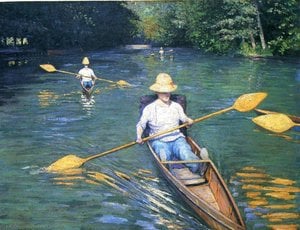
A Moment of Tranquility: Caillebotte's "The Canoes"
Gustave Caillebotte’s “The Canoes,” painted in 1878, is more than just a depiction of two men navigating a tranquil waterway; it’s a carefully constructed tableau that embodies the burgeoning Impressionist movement and captures a fleeting moment of quiet contemplation within the rapidly changing landscape of late 19th-century Paris. Measuring 156 x 109 cm, this oil on canvas work invites viewers into a world where light and atmosphere hold as much significance as the subjects themselves.
- Subject Matter: The painting centers around two men engaged in a simple activity – canoeing – a scene remarkably ordinary yet imbued with an extraordinary sense of serenity.
- Impressionist Technique: Caillebotte’s masterful use of broken brushstrokes and vibrant color reflects the core tenets of Impressionism, prioritizing the immediate sensation of light and its effect on form rather than meticulous detail.
- Composition: The composition is deliberately balanced, drawing the eye across the canvas with a subtle diagonal created by the canoes' movement and the implied flow of the water.
The Artist’s Vision: Caillebotte and the Rise of Impressionism
Gustave Caillebotte (1848-1894) emerged as a pivotal figure in the Parisian art scene, profoundly influenced by both his privileged upbringing and his keen observation of modern life. Born into a wealthy family involved in the textile trade, he possessed the financial freedom to pursue his artistic passions without the constraints of commercial necessity. This afforded him access to exceptional training – initially under Léon Bonnat – and, crucially, an early fascination with photography. As you can see from the painting, Caillebotte’s exposure to photographic techniques—particularly its ability to capture fleeting moments and precise perspectives—directly shaped his artistic approach. He wasn't simply painting what he saw; he was meticulously constructing a visual experience, much like a photographer composing a shot.
His work reflects the anxieties and excitement of a city undergoing rapid transformation – industrialization, urbanization, and the rise of new social classes. “The Canoes” can be interpreted as a quiet resistance to this upheaval, a yearning for simplicity and connection with nature within the heart of a bustling metropolis.
Decoding the Details: Light, Color, and Symbolism
Caillebotte’s palette is dominated by muted greens, blues, and browns, creating an atmosphere of cool tranquility. The artist skillfully employs light to model the canoes and the figures, suggesting movement and depth through subtle variations in tone and color. Note the way the sunlight glints off the water's surface – a hallmark of Impressionist technique. The inclusion of a bird soaring above adds a layer of symbolic richness, representing freedom, aspiration, or perhaps a connection to the natural world amidst the urban environment.
- Color Palette: Muted greens, blues, and browns evoke tranquility and reflect the natural setting.
- Light & Shadow: Caillebotte’s use of light creates depth and suggests movement within the scene.
- Symbolism: The bird adds a layer of meaning, potentially representing freedom or connection to nature.
A Legacy of Impressionistic Beauty
"The Canoes" stands as a testament to Gustave Caillebotte’s artistic vision and his pivotal role in the development of Impressionism. This painting is not merely a beautiful image; it's an invitation to pause, reflect, and appreciate the subtle beauty of everyday moments – a timeless message that continues to resonate with art lovers today. Its meticulous detail and masterful execution make it a superb subject for a hand-painted reproduction, allowing you to bring this serene scene into your own space.



 معاينة الحجم الحقيقي
 اشترِ لوحة مرسومة يدويًا
 مشاركة
 مشاركة
 التفاصيل

 تحميل الملف
 قطع مشابهة
 الأشعة السينية
 عرض شرائح


 عرض المزيد






































 خيار الزجاج متاح فقط للمقاسات التي تقل عن 110 سم