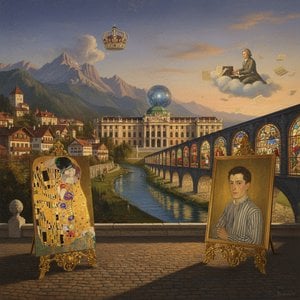
A Vision in Gold: Exploring Gustav Klimt’s “The Girl Looking Down”
Gustav Klimt, a titan of the Vienna Secession movement, remains an artist whose work continues to fascinate audiences worldwide. Among his prolific oeuvre, “Herabblickendes Mädchen,” or “The Girl Looking Down,” stands as arguably his most poignant exploration of femininity and artistic innovation. Painted in 1907-1908 during Klimt’s celebrated ‘Golden Period,’ this monumental canvas transcends mere portraiture; it embodies a profound meditation on the female psyche and the cyclical nature of life itself.
- Subject Matter: The painting depicts a young woman seated before a wall, her gaze directed downwards at her hands. This seemingly simple pose is imbued with complex symbolism—a gesture of contemplation, vulnerability, and an acknowledgement of inner reflection.
- Style & Technique: Klimt’s signature style – characterized by opulent ornamentation and vibrant color palettes – dominates “The Girl Looking Down.” He employs a masterful blend of oil paint and gold leaf, creating textures that shimmer with luminosity and conveying a sense of ethereal beauty. The intricate geometric patterns interwoven throughout the composition contribute to its visual richness and reinforce its symbolic significance.
Vienna Secession: Challenging Artistic Conventions
“Herabblickendes Mädchen” emerged from the crucible of Vienna Secession, a revolutionary artistic collective founded by Klimt alongside Emil Schiele and Josef Maria Olbrich in 1897. Rejecting the conservative academic traditions prevalent at the time, Secession artists championed individualism, experimentation, and a rejection of bourgeois morality. They sought to forge a new aesthetic language rooted in Symbolism and influenced by Art Nouveau—a movement that celebrated organic forms and decorative embellishment.
- Historical Context: The painting reflects the broader intellectual currents of its era – anxieties surrounding gender roles, fascination with psychoanalysis (particularly Freud’s burgeoning influence), and a yearning for spiritual renewal. Klimt's Secession contemporaries were actively engaged in debates about artistic freedom and social responsibility.
- Influence: “The Girl Looking Down” profoundly impacted subsequent generations of artists, establishing Klimt as a pioneer of Expressionism and paving the way for explorations of psychological depth within visual art.
Symbolic Layers: Decoding the Visual Language
Klimt’s meticulous attention to detail extends beyond mere surface appearance; every element in “The Girl Looking Down” carries symbolic weight. The woman's downward gaze represents introspection and an awareness of one's own inner world—a theme central to Klimt’s broader artistic vision. The gold leaf, a recurring motif in his work, symbolizes divinity, immortality, and the transformative power of beauty. Furthermore, the geometric patterns adorning the wall serve as visual anchors, grounding the figure within a framework of cosmic order.
Consider this: “The Girl Looking Down” invites viewers to contemplate themes of femininity, contemplation, and the cyclical journey from innocence to maturity—a timeless exploration of human experience rendered with unparalleled artistic brilliance. Its enduring appeal lies in Klimt’s ability to capture not just a likeness but also an emotional essence that resonates across cultures and generations.
Experience Klimt's Legacy
At WahooArt.com, you can immerse yourself in the splendor of Klimt’s masterpiece with our meticulously crafted reproductions. Each hand-painted replica captures the luminous quality of gold leaf and the intricate beauty of Klimt’s distinctive style—bringing a piece of Viennese Symbolism into your home.



 معاينة الحجم الحقيقي
 اشترِ نسخة مطبوعة
 مشاركة
 مشاركة
 التفاصيل

 تحميل الملف
 قطع مشابهة
 الأشعة السينية
 عرض شرائح

 عرض المزيد






































 خيار الزجاج متاح فقط للمقاسات التي تقل عن 110 سم