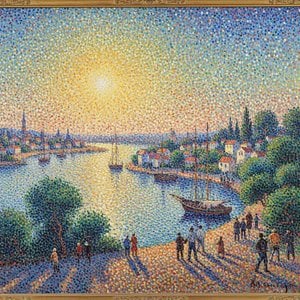
Georges Seurat’s *A Sunday Afternoon on the Island of La Grande Jatte* – A Symphony of Light and Modernity
Georges Pierre Seurat's *A Sunday Afternoon on the Island of La Grande Jatte*, completed between 1884 and 1886, stands as a monumental achievement not just within Impressionism, but as a foundational work of modern art. More than simply a depiction of a Parisian leisure scene, it’s a meticulously constructed meditation on time, modernity, and the evolving relationship between humanity and its environment – a theme that continues to resonate powerfully today. The painting's scale alone—a colossal 17 feet by 25 feet—immediately commands attention, drawing the viewer into a world of carefully orchestrated observation and scientific precision.
- The Technique: Pointillism Seurat’s revolutionary technique, known as Pointillism or Divisionism, is the very heart of this masterpiece. Rather than blending colors directly on the canvas, he applied tiny dots of pure color – meticulously calculated to create optical mixtures when viewed from a distance. This method, inspired by scientific theories of optics and championed by Seurat himself, aimed to capture the fleeting effects of light and atmosphere with unprecedented accuracy.
- Color Theory The painting’s palette is remarkably restrained, dominated by blues, greens, ochres, and browns – colors that evoke the hazy summer afternoon and the industrial landscape surrounding La Grande Jatte. Seurat's understanding of color theory was exceptional; he used complementary colors strategically to heighten visual impact and create a sense of shimmering light.
- Composition The composition is carefully balanced, with figures arranged in shallow depth planes, creating an illusion of space that’s both realistic and stylized. The diagonal lines of the boats and the receding shoreline draw the viewer's eye into the scene, while the central grouping of figures anchors the composition.
A Reflection on Modern Life
Painted during a period of rapid industrialization and social change in Paris, *A Sunday Afternoon* offers a complex commentary on the burgeoning modern world. The island itself was a popular leisure spot for Parisians escaping the city’s bustle, but Seurat presents a scene that feels strangely detached from everyday life. The figures are posed awkwardly, seemingly unaware of each other, and their activities – boating, sunbathing, picnicking – feel almost ritualistic. This detachment reflects the growing alienation and anonymity experienced by individuals in an increasingly urbanized society.
Symbolism: Some scholars interpret the painting as a critique of bourgeois leisure, suggesting that the figures’ detached behavior represents a superficial enjoyment of wealth and status. The industrial backdrop – the factory chimneys and the boats powered by steam – subtly underscores the impact of technology on human life. The painting's stillness is also significant; it captures a moment frozen in time, reflecting the anxieties surrounding the relentless march of progress.
Historical Context & Seurat’s Vision
Seurat was deeply influenced by scientific advancements of the late 19th century, particularly those related to optics and color theory. He studied the work of Eugène Delacroix, but rejected his expressive brushwork in favor of a more objective approach. His ambition was not simply to paint what he saw, but to capture the *impression* of light and atmosphere with scientific rigor. This pursuit led him to develop Pointillism as a revolutionary technique that would transform the course of modern art.
Neo-Impressionism: Seurat’s work is considered a cornerstone of Neo-Impressionism, an artistic movement that emerged in response to Impressionism. While Impressionists focused on capturing fleeting moments of light and color, Neo-Impressionists, led by Seurat and Paul Signac, employed scientific principles to create works with a more structured and systematic approach. *A Sunday Afternoon* is arguably the most significant example of this movement.
Emotional Impact & Legacy
Despite its intellectual rigor, *A Sunday Afternoon on the Island of La Grande Jatte* possesses a profound emotional impact. The painting’s scale, combined with Seurat's masterful use of color and light, creates a sense of immersive beauty that draws the viewer into the scene. It is a work that invites contemplation – about time, modernity, human connection, and the enduring power of art to capture the essence of our experience.



 معاينة الحجم الحقيقي
 اشترِ لوحة مرسومة يدويًا
 مشاركة
 مشاركة
 التفاصيل

 تحميل الملف
 قطع مشابهة
 الأشعة السينية
 عرض شرائح
 الإحصائيات

 عرض المزيد






































 خيار الزجاج متاح فقط للمقاسات التي تقل عن 110 سم