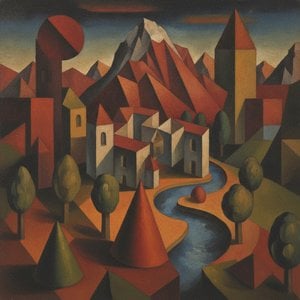
A Fragmented Echo: Georges Braque’s “The Clarinet”
Georges Braque's "The Clarinet," a work shrouded in the quiet intensity of early Cubism, isn’t merely a depiction of an instrument; it’s a carefully constructed meditation on perception and form. Born in Argenteuil in 1882, Braque’s artistic lineage was deeply rooted in the practical world – his father and grandfather were house painters and decorators, providing him with an invaluable understanding of materials and spatial relationships. This grounding, combined with his rigorous training at the École des Beaux-Arts and subsequent immersion in the Parisian art scene, fueled a revolutionary approach to painting that would forever alter the course of modern art. “The Clarinet” embodies this shift, moving beyond traditional representation towards a deconstructed reality where geometry reigns supreme.
The artwork immediately commands attention with its restrained palette – a symphony of browns, grays, and beiges that evokes the muted tones of an industrial landscape or perhaps the interior of a dimly lit music hall. These earthy hues are juxtaposed against a stark white background, amplifying the angularity of the shapes and creating a sense of both austerity and intrigue. The subject itself is fragmented; recognizable architectural elements – windows, walls, even hints of musical instruments – are broken down into their constituent geometric forms: rectangles, trapezoids, and sharp-edged planes. This deliberate dismantling isn’t arbitrary; it's a core tenet of Cubism, an attempt to capture the simultaneous viewpoints inherent in observing an object from multiple angles. The artist doesn’t offer a single, fixed perspective but instead presents a dynamic, multi-faceted representation that challenges our conventional understanding of space.
Deconstructing Space and Form: Braque's Cubist Vision
Braque’s technique is characterized by a meticulous layering and collage approach. Evidence suggests the use of paper or cardboard for the shapes themselves, perhaps combined with charcoal or pencil to define outlines and create subtle shading. This layering creates an illusion of depth – not through realistic perspective, but through overlapping planes and variations in tone. The flattened picture plane, a hallmark of Cubism, further reinforces this sense of spatial ambiguity. It’s as if the artist is constructing a new reality from the fragments of the old, inviting the viewer to actively participate in the process of interpretation.
The influence of Paul Cézanne is palpable here; Braque, along with Pablo Picasso, was deeply inspired by Cézanne's exploration of form and structure. However, while Cézanne sought to capture the underlying geometry of nature, Braque pushed this concept further, reducing objects to their essential shapes and presenting them in a deliberately fragmented manner. The text fragments, subtly integrated into the composition, add another layer of complexity, hinting at urban environments or perhaps even musical notation – reinforcing the connection between architecture, space, and sound.
Symbolism and Emotional Resonance
While “The Clarinet” avoids overt emotional expression, it possesses a quiet intensity that speaks to themes of fragmentation, perception, and the deconstruction of reality. The clarinet itself, an instrument associated with melody and emotion, is rendered in a detached, almost clinical manner, suggesting a separation from its traditional connotations. It’s possible to interpret the work as a commentary on the breakdown of established order – both artistic and societal – that characterized the early 20th century. The angular lines and geometric forms can be seen as representing the anxieties and uncertainties of a rapidly changing world.
Ultimately, “The Clarinet” is more than just a still life; it’s a profound exploration of how we perceive and represent reality. Its austere beauty and intellectual rigor make it a compelling addition to any collection, offering a glimpse into the mind of one of the most influential artists of the modern era. A hand-painted reproduction captures the essence of Braque's vision with remarkable fidelity, allowing you to bring this enigmatic masterpiece into your own space – a testament to the enduring power of Cubist abstraction.
الأسئلة والأجوبة
كيف يمكنني معاينة نسخة من "The Clarinet" للفنان جورج براك؟
لمعاينة نسخة من "The Clarinet" للفنان جورج براك، افتح صفحة معاينة الخاصة بالعمل الفني.
من هو الفنان وما هو الأسلوب الذي يجسده العمل "The Clarinet"؟
أبدع جورج براك لوحة "The Clarinet" بأسلوب Cubism. ويحدد الفنان والمدرسة الفنية التراث الذي ينتمي إليه هذا العمل.
إلى أي مرحلة من مسيرة جورج براك الفنية تنتمي لوحة "The Clarinet"؟
"The Clarinet" represents the Early Cubism of جورج براك.



 معاينة الحجم الواقعي
 اطلب نسخة مرسومة يدويًا
 إرسال
إرسال مشاركة
 عرض التفاصيل
 دليل الأعمال الفنية للطلاب

 تحميل
تحميل
 قطع مشابهة
 الأشعة السينية
 عرض شرائح متتابع
 الإحصائيات
 اقرأ المزيد






































 خيار الزجاج متاح فقط للمقاسات التي تقل عن 110 سم