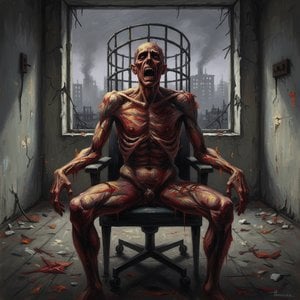
A Portrait of Existential Angst: Exploring Francis Bacon’s “Three Studies for Self-Portrait”
Francis Bacon's "Three Studies for Self-Portrait," created in 1980, stands as a chilling testament to the artist’s preoccupation with psychological torment and the unsettling realities of human existence. More than just a depiction of his own visage—though undeniably centered on a meticulously rendered face—this painting delves into the depths of consciousness, presenting a fragmented image that embodies the anxieties inherent in confronting oneself.
The artwork belongs to Bacon’s signature style: Surrealism infused with Expressionism. Unlike traditional portraiture aiming for idealized beauty, Bacon deliberately distorted anatomical proportions and employed grotesque imagery – a deliberate rejection of academic conventions—to convey inner turmoil. The central panel showcases a man's face rendered in shades of pink, red, and grey, punctuated by piercing eyes that stare directly out at the viewer. The exaggerated features—a prominent nose, crimson lips—are not merely anatomical inaccuracies but symbolic representations of vulnerability and emotional intensity.
Bacon’s technique involved applying paint thickly onto canvas with palette knives – a method he championed throughout his career – creating textured surfaces that capture the physicality of emotion. He utilized encaustic wax alongside oil paints, layering pigments to achieve remarkable luminosity and depth. This process wasn't merely about replicating appearance; it was about channeling feeling directly onto the canvas, imbuing each brushstroke with palpable urgency.
Created in the aftermath of World War II, “Three Studies for Self-Portrait” reflects the pervasive disillusionment felt by artists grappling with the trauma and moral ambiguities of the era. Bacon’s work aligns with broader artistic explorations into themes of mortality, isolation, and the disintegration of identity—concepts that resonated powerfully during a period marked by profound societal upheaval. The painting's unsettling gaze compels contemplation on the human condition, prompting viewers to confront their own fears and insecurities.
Symbolically, the fragmented face embodies the fractured psyche, mirroring Bacon’s own struggles with mental illness. The colors—pink, red, grey—represent not only physical sensations but also emotional states: vulnerability, rage, despair. Ultimately, “Three Studies for Self-Portrait” transcends mere visual representation; it is an emotionally charged exploration of the human spirit's capacity for suffering and its relentless pursuit of self-awareness.
This artwork continues to captivate audiences today, serving as a poignant reminder that art can illuminate the darkest corners of our inner lives. Its enduring appeal lies in its uncompromising honesty—a refusal to sugarcoat reality—and its ability to provoke profound introspection. Collectors and interior designers alike appreciate its masterful execution and its capacity to evoke visceral responses.



 معاينة الحجم الحقيقي
 اشترِ لوحة مرسومة يدويًا
 مشاركة
 مشاركة
 التفاصيل

 تحميل الملف
 قطع مشابهة
 الأشعة السينية
 عرض شرائح
 الإحصائيات

 عرض المزيد






































 خيار الزجاج متاح فقط للمقاسات التي تقل عن 110 سم


![Study For A Portrait [looking Right], — فرانسيس بيكون, Expressionist Painting](/media/artworks/images-thumb/87/b7/87b70ef44d2bec32f057076c0dd56be2.jpg)