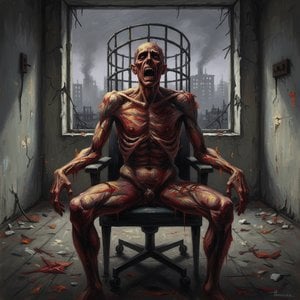
A Visceral Portrait of Anxiety: Francis Bacon’s Self-Portrait, 1969
Francis Bacon's "Self-Portrait," painted in 1969, isn’t merely a depiction of the artist; it’s an unflinching exploration of the human psyche grappling with isolation and existential dread. This work, rendered in oil on canvas, stands as a cornerstone of his intensely personal and profoundly unsettling oeuvre, embodying the raw emotionality that defined his career. It's a painting that demands attention, not for its beauty in the conventional sense, but for its brutal honesty and the palpable sense of unease it evokes.
Composition and Technique: Distortion as Revelation
The composition is strikingly immediate – a tight crop focusing relentlessly on Bacon’s head and upper torso. This claustrophobic framing immediately establishes a feeling of confinement, mirroring the psychological state the painting suggests. The background is a deep, almost suffocating blue, amplifying the pallor of his skin and creating an unsettling contrast. Bacon eschews traditional perspective, flattening the image and reducing depth, contributing to the overall sense of disorientation. His technique is characterized by loose, gestural brushstrokes – thick applications of paint layered upon each other in swirling patterns. These aren’t carefully blended or smoothed; instead, they retain a visible physicality, conveying a sense of urgency and movement as if the very emotions are being flung onto the canvas.
Color, Symbolism, and the Mask
The color palette is deliberately muted – grays, browns, creams, and flashes of orange/yellow around the mouth. This somber range reinforces the painting’s melancholic mood. The prominent use of these cool tones creates a sense of detachment, while the brief bursts of warm color, particularly around the lips and cigarette, hint at a desperate attempt to grasp at something – perhaps pleasure, or simply an escape from the overwhelming darkness. Crucially, Bacon employs a mask-like covering over the lower half of the face. This deliberate concealment is laden with symbolic weight; it suggests repression, hidden anxieties, or perhaps even a fundamental disconnect from one’s own self. The cigarette itself has become a potent symbol within Bacon's work – often interpreted as representing self-destruction, a coping mechanism for unbearable emotional pain, or simply a visual shorthand for the artist’s own troubled existence.
An Expressionist Masterpiece: Exploring the Fragmented Self
“Self-Portrait, 1969” is undeniably an expressionistic work. Bacon wasn't interested in replicating reality; he sought to externalize inner turmoil. The distorted features – the bulging eyes, the elongated nose, the gaping mouth – are not meant to be taken literally but rather as visual metaphors for psychological distress. The painting taps into a deep well of anxiety and alienation that resonated powerfully with audiences during the turbulent post-war era. Bacon’s work reflects a broader cultural unease about identity, mortality, and the breakdown of traditional values. It's a testament to his ability to translate profound emotional experiences onto canvas, creating images that are both disturbing and deeply affecting. As art historian Hugo Maertens notes, “This self-portrait encapsulates Bacon’s fascination with the human condition, expressing vulnerability and turmoil through his distinctive, bold, and unflinchingly raw style.”
Collecting a Reproduction: Bringing the Intensity Home
WahooArt offers meticulously crafted hand-painted reproductions of Francis Bacon's "Self-Portrait, 1969," allowing you to experience the power and intensity of this iconic work in your own space. Our artists faithfully recreate Bacon’s distinctive technique – the layered brushstrokes, the bold colors, and the unsettling distortions – ensuring a faithful representation of his artistic vision. Whether for a gallery wall or as a striking statement piece within an interior design scheme, a WahooArt reproduction offers a unique opportunity to engage with one of the 20th century’s most significant artists.



 معاينة الحجم الحقيقي
 التحويل إلى المطبوعات
 مشاركة
 مشاركة
 التفاصيل

 تحميل الملف
 قطع مشابهة
 الأشعة السينية
 عرض شرائح
 الإحصائيات

 عرض المزيد






































 خيار الزجاج متاح فقط للمقاسات التي تقل عن 110 سم