A Monument to Modernity: Decoding Léger’s *The Viaduct*
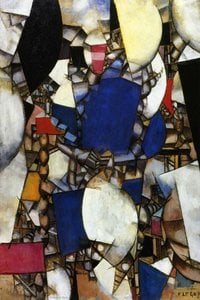
Fernand Léger's The Viaduct isn’t simply a depiction of an industrial scene; it is a bold declaration of faith in the machine age, rendered with his signature “Tubism” – a uniquely powerful evolution of Cubist principles. This painting transforms steel, brick, and the dynamism of transportation into a compelling visual symphony of form and color.
Deconstructing the Scene: Form & Technique
The composition is anchored by a robust, predominantly yellow building dramatically intersected by a viaduct – an elevated railway bridge. A speeding train on the right injects immediate energy and movement. Léger masterfully employs cylindrical forms, breaking down architectural elements and even human figures into simplified geometric shapes. These aren’t merely representations; they are *constructions*, emphasizing the underlying structural logic of the modern world.
Two subtly integrated human figures appear within this mechanical landscape – one positioned near the left edge and another closer to the center. They almost function as components within the larger machine, rather than independent observers, hinting at humanity’s evolving relationship with technology. A clock prominently placed in the top-left corner isn't a mere detail; it symbolizes Léger’s fascination with time, efficiency, and the rhythmic pulse of modern life.
Léger achieves his striking effect through flat planes of color – primarily yellows, reds, blues, and grays – and strong contrasts. He deliberately rejects traditional modeling techniques in favor of a more graphic, almost poster-like approach, enhancing the painting’s visual impact and immediacy.
Historical Context: Embracing the Industrial Revolution
Born in 1881, Léger lived through a period of rapid industrialization. Unlike many artists who mourned the loss of tradition, he wholeheartedly embraced it. He perceived beauty and heroism within machinery, believing it represented a new aesthetic possibility. Developing his distinctive style around 1910, he moved beyond analytical Cubism towards a more figurative and accessible form – “Tubism” – which focused on the inherent structural qualities of objects.
The Viaduct perfectly exemplifies this artistic evolution. It’s not just *about* industry; it's an attempt to capture its very essence, its underlying structure, and its profound impact on human experience. Léger’s work anticipated the Pop Art movement decades later with its embrace of everyday objects and mass-produced imagery.
Symbolism & Emotional Resonance
The painting evokes a sense of dynamism and optimism, yet also carries an undercurrent of detachment. The anonymized figures suggest the individual’s place within the vast industrial system. It's a powerful statement about modernity – its energy, scale, and potential for both progress *and* alienation.
Display & Interior Design Considerations
- Setting: The Viaduct would be stunning in modern or contemporary spaces. Its bold colors and geometric forms complement minimalist interiors.
- Complementary Furniture: Pair it with furniture featuring clean lines and industrial materials like steel, concrete, or polished wood.
- Lighting: A well-lit room is essential to showcase the vibrancy of Léger’s palette. Consider focused lighting to highlight the texture and color variations.
- Scale & Space: Allow ample breathing space around the artwork to maximize its impact. The painting's size (once known) will dictate ideal placement, but avoid overcrowding.
The Viaduct is more than just a painting; it’s a visual manifesto celebrating the beauty and complexity of the modern world – a testament to Fernand Léger’s visionary artistry. It invites viewers to contemplate not only what we build, but also how those creations shape our lives.
الأسئلة والأجوبة
أين تقع لوحة "The viaduct" ضمن المجموعة الكاملة لأعمال فرناند ليجر؟
ينتمي العمل "The viaduct" إلى أعمال فرناند ليجر ضمن مدرسة Cubism، والتي تشمل موضوعاتها المسجلة cubist abstraction, industrial cityscape, geometric dynamism, modern urban life, leger's machine age, early 20th century, form and movement, simplified reality.
ما هي الوسائط المستخدمة في تنفيذ "The viaduct" للفنان فرناند ليجر؟
تم تنفيذ "The viaduct" باستخدام Acrylic On Canvas.
كم عدد الأشخاص الذين يشاهدون "The viaduct"؟
تتوفر الإحصائيات الخاصة بـ "The viaduct" للفنان فرناند ليجر في صفحة الإحصائيات للعمل الفني: وتشمل الزيارات الشهرية للعمل، وزيارات أعمال الفنان، وتوزيع الزوار الأخيرين حسب الدولة واللغة.



 معاينة الحجم الواقعي
 اطلب نسخة مرسومة يدويًا
 إرسال
إرسال مشاركة
 عرض التفاصيل
 دليل الأعمال الفنية للطلاب

 تحميل
تحميل
 قطع مشابهة
 الأشعة السينية
 عرض شرائح متتابع
 الإحصائيات

 اقرأ المزيد






































 خيار الزجاج متاح فقط للمقاسات التي تقل عن 110 سم