A Symphony of Geometry and Industry
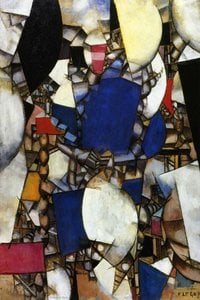
In the heart of the early twentieth century, as the gears of progress began to turn with an unstoppable momentum, Fernand Léger captured a moment of profound transformation in his 1913 masterpiece, "The House in the Trees." This is not merely a landscape viewed through a window, but a bold, Cubist manifesto that confronts the viewer with the collision of the organic and the mechanical. Through a deliberate simplification of form, Léger fractures the natural world into a rhythmic arrangement of cubes, cylinders, and cones. The painting invites us to look beyond the surface of reality, offering a vision where the soft edges of nature are being reshaped by the sharp, precise lines of an emerging industrial age. For the discerning collector, this piece offers more than just visual interest; it provides a window into a pivotal era of human history.
The technique employed in this work distinguishes Léger from his contemporaries, such as Picasso or Braque. While others sought to deconstruct objects into complex puzzles, Léger embraced a certain monumental clarity. He utilizes a muted, earthy palette—rich ochres, deep browns, and somber greys—to ground his abstract geometries in a tangible, material reality. This choice of color evokes the very essence of the industrial landscape: the soot, the earth, and the raw materials of construction. The composition is a complex dance of shapes, where bottles are scattered across the canvas like rhythmic notes in a mechanical symphony. These objects, rendered with striking geometric precision, create an illusionistic space that feels both structured and dynamic, making it an ideal focal point for modern interiors seeking a sense of intellectual depth and structural elegance.
Symbolism and the Spirit of Modernity
Beyond its striking visual architecture, "The House in the Trees" is steeped in profound symbolism. The recurring motif of bottles—a signature element in Léger’s oeuvre—serves as a powerful metaphor for the era's duality. On one hand, they represent the abundance and mass production of an industrializing society; on a deeper level, their fragile glass forms mirror the vulnerability of human existence amidst the rapid, often turbulent, shifts of technological advancement. Painted on the cusp of World War I, the work vibrates with the latent anxieties and soaring aspirations of a generation standing on the precipice of unprecedented change. The interplay between the scattered vessels and the structured landscape suggests a world in flux, where the domestic and the industrial are inextricably linked.
For interior designers and art enthusiasts alike, this painting offers an unparalleled emotional resonance. It possesses a unique ability to command attention through its rhythmic repetition and structural strength, yet it maintains a contemplative atmosphere that encourages long periods of reflection. To possess a reproduction of this work is to bring a piece of the avant-garde revolution into one's personal space—a tribute to the beauty found in precision, the strength found in form, and the enduring fascination with the pulse of the modern world.



 معاينة الحجم الحقيقي
 اشترِ لوحة مرسومة يدويًا
 مشاركة
 مشاركة
 التفاصيل
 الدليل

 تحميل الملف
 قطع مشابهة
 الأشعة السينية
 عرض شرائح
 الإحصائيات

 عرض المزيد






































 خيار الزجاج متاح فقط للمقاسات التي تقل عن 110 سم