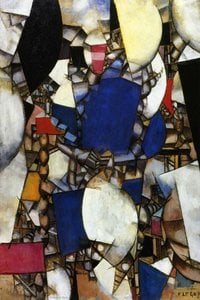
Fernand Léger, a prominent figure in the Cubism movement, created "Staircase" in 1914. This painting is a quintessential example of Cubist art, characterized by its geometric forms and fragmented objects.
Composition and Elements
The scene depicts a stairwell with various objects scattered throughout the space. Multiple cups of different sizes are placed on the steps, some closer to the viewer and others further away. A bowl is located near the center of the painting, while a vase is positioned towards the left side. Several bottles are scattered throughout the scene, with one close to the top right corner, another in the middle-right area, and two more on the bottom right side. A chair can be seen near the center of the painting, while a clock is located towards the upper left corner.
Cubism and Proto-Cubism
Cubism, pioneered by Pablo Picasso and Georges Braque, revolutionized painting and visual arts in the early 20th century. The movement influenced artistic innovations in music, ballet, literature, and architecture. Cubist subjects are analyzed, broken up, and reassembled in an abstract form, depicting multiple perspectives to represent the subject in a greater context. Proto-Cubism, also referred to as Protocubism, Early Cubism, and Pre-Cubism or Précubisme, is an intermediary transition phase in the history of art chronologically extending from 1906 to 1910. This period is characterized by a move towards the radical geometrization of form and a reduction or limitation of the color palette.
Artistic Influences
Fernand Léger's "Staircase" reflects the influence of Paul Cézanne's late works, which represented three-dimensional forms in a more geometric manner. The painting also showcases the artist's adherence to the principles of Cubism, as seen in the fragmented objects and multiple perspectives.
Relevance and Legacy
Cubism has been considered the most influential art movement of the 20th century. Its impact was far-reaching and wide-ranging in the arts and popular culture. The movement introduced collage as a modern art form and influenced various offshoots, including Orphism, abstract art, Futurism, Suprematism, Dada, Constructivism, De Stijl, and Art Deco. In conclusion, Fernand Léger's "Staircase" is a significant work in the Cubist movement, showcasing the artist's skillful use of geometric forms and fragmented objects. The painting reflects the influence of Cézanne and the principles of Cubism, contributing to the movement's lasting impact on modern art.
الأسئلة والأجوبة
أين يمكنني العثور على إحصائيات حول "Staircase 19" للفنان فرناند ليجر؟
توجد صفحة الإحصائيات خاصة بـ "Staircase 19"، حيث تعرض مخططاً للزيارات الشهرية لهذا العمل الفني ولأعمال الفنان الأخرى، مع تفصيل حسب الدولة واللغة.
من هو الفنان وما هو الأسلوب الذي يجسده العمل "Staircase 19"؟
أبدع فرناند ليجر لوحة "Staircase 19" ضمن حركة Cubism.
هل "Staircase 19" للفنان فرناند ليجر ضمن الملكية العامة؟
تندرج لوحة "Staircase 19" للفنان فرناند ليجر ضمن ملك عام - انتهت مدة حماية حقوق الطبع والنشر الخاصة به. وتحدد هذه الحالة كيفية إعادة إنتاج صورة العمل الفني.
متى تم إنجاز "Staircase 19"؟
يعود تاريخ "Staircase 19" إلى عام 1914، وهو تاريخ يضع العمل ضمن المسيرة المهنية لـ فرناند ليجر وفي سياق حقبته الزمنية.
كم كان عمر فرناند ليجر عندما أُبدع العمل "Staircase 19"؟
عندما أُبدع العمل "Staircase 19" في عام 1914، كان عمر الفنان فرناند ليجر - المولود في 1881 - هو 33 عاماً.
كيف تُوصف لوحة ألوان "Staircase 19" للفنان فرناند ليجر؟
تُشكل ألوان "Staircase 19" لوحة ألوان من نوع Neutrals. ويصف هذا التصنيف عائلات الألوان المهيمنة.
من الذي أبدع "Staircase 19"؟
تم إبداع "Staircase 19" بواسطة فرناند ليجر. وتصف المعلومات الواردة في هذه الصفحة العمل الأصلي لـ فرناند ليجر.



 معاينة الحجم الواقعي
 اطلب نسخة مرسومة يدويًا
 إرسال
إرسال مشاركة
 عرض التفاصيل
 دليل الأعمال الفنية للطلاب

 تحميل
تحميل
 قطع مشابهة
 الأشعة السينية
 عرض شرائح متتابع
 الإحصائيات

 اقرأ المزيد






































 خيار الزجاج متاح فقط للمقاسات التي تقل عن 110 سم