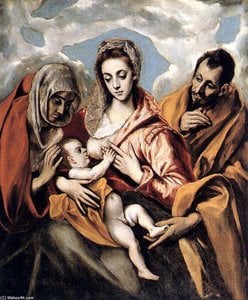
A Testament to Faith and Artistic Innovation: Exploring El Greco’s Bust of an Apostle
Doménikos Theotokópoulos, universally recognized as El Greco – “The Greek” – stands as a singular figure in the artistic landscape of the Spanish Renaissance. Born in Crete in 1541 amidst the waning influence of Byzantium and blossoming under Venetian patronage, his career traversed Europe, culminating in Toledo, Spain, where he cemented his legacy as one of art history’s most influential innovators.
- Subject Matter: The sculpture portrays an apostle—a central figure within Christian iconography—representing piety, devotion, and the embodiment of spiritual aspiration. Its deliberate positioning reflects a profound engagement with religious themes prevalent during El Greco's era.
- Style & Technique: El Greco’s distinctive Mannerist style distinguishes itself from its predecessors through elongated figures, stylized drapery, and dramatic chiaroscuro—the masterful interplay of light and shadow—techniques that foreshadowed the expressive fervor of Expressionism decades later. The artist meticulously crafted a bust utilizing marble, prioritizing anatomical accuracy alongside emotive distortion to convey inner turmoil and spiritual intensity.
- Composition: Centered on the apostle’s head and shoulders, cropped just below the chest, the composition employs asymmetrical balance—a subtle shift to the right—creating visual dynamism. The dark background serves as a canvas for highlighting the sculpture's contours and emphasizing its monumental presence.
Material & Craftsmanship: Marble and Dramatic Light
The choice of marble speaks volumes about El Greco’s artistic sensibilities – it symbolizes purity, permanence, and intellectual contemplation. The sculptor skillfully employed chiseling and polishing techniques to achieve a surface texture that captures the subtle nuances of light and shadow. This meticulous attention to detail underscores the artist's commitment to realism while simultaneously elevating the bust beyond mere representation into an evocative symbol of faith.
Symbolism & Emotional Resonance
The apostle’s gaze upward—slightly to the left—is laden with symbolic significance, suggesting a yearning for transcendence and divine grace. The artist's masterful manipulation of form conveys not only anatomical precision but also palpable emotion – a profound contemplation that resonates deeply within the viewer. This expressive distortion aligns perfectly with El Greco’s broader artistic vision: to capture the spiritual essence of his subjects.
Historical Context & Artistic Legacy
El Greco's work emerged during a period marked by religious fervor and intellectual curiosity—the Spanish Renaissance witnessed a revival of classical ideals alongside burgeoning humanist thought. Yet, El Greco defied categorization, forging a path entirely his own. His influence extended far beyond his lifetime, inspiring artists across Europe and shaping the trajectory of artistic expression for centuries to come. As exemplified in the Museo de El Greco in Toledo, Spain—a meticulously recreated 16th-century home—his enduring legacy continues to captivate audiences worldwide.



 معاينة الحجم الحقيقي
 اشترِ لوحة مرسومة يدويًا
 مشاركة
 مشاركة
 التفاصيل

 تحميل الملف
 قطع مشابهة
 الأشعة السينية
 عرض شرائح
 الإحصائيات
 عرض المزيد






































 خيار الزجاج متاح فقط للمقاسات التي تقل عن 110 سم