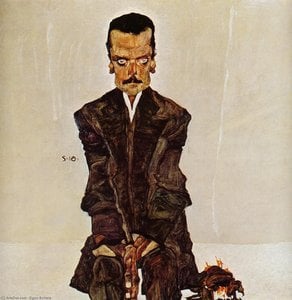
A Study in Vulnerability: Egon Schiele’s ‘Female Nude – Back View’
Egon Schiele's “Female Nude – Back View,” painted in 1913, is not merely a depiction of the human form; it’s a raw and unsettling exploration of mortality, isolation, and the precariousness of existence. Emerging from the turbulent backdrop of early 20th-century Vienna, Schiele's work was profoundly shaped by personal tragedy – the loss of his father to syphilis and later his sister – themes that relentlessly surface in his intensely emotive oeuvre. This particular piece, a study in back view, immediately draws the viewer into a space of quiet contemplation, yet one laced with an undeniable sense of unease. The subject’s posture, often interpreted as hanging from a rope or chain (though this is not explicitly shown), speaks to a vulnerability that transcends simple physical representation; it embodies a feeling of suspension, of being caught between worlds.
Expressionist Boldness: Form and Color
Schiele’s artistic style during this period firmly aligns with the tenets of Expressionism. He abandons traditional academic realism in favor of distorted forms, exaggerated lines, and a deliberately jarring palette. The colors are not used to create illusionistic beauty but rather to convey emotional intensity – deep blues and purples dominate, suggesting melancholy and perhaps even despair, while flashes of crimson hint at underlying passion or violence. Notice the deliberate lack of detail; Schiele wasn’t interested in rendering every curve and contour with photographic precision. Instead, he employed a simplified, almost skeletal approach, emphasizing the essential lines of the body to amplify its emotional weight. The brushstrokes themselves are visible, contributing to the painting's sense of immediacy and urgency.
- Line as Emotion: Schiele’s signature use of jagged, broken lines is paramount here. They don’t simply outline the figure; they *are* the emotion – a restless energy that vibrates through the canvas.
- Color Palette: The somber hues evoke feelings of loneliness and introspection, reflecting the artist's own struggles with loss and mortality.
- Simplified Forms: Reducing the figure to its essential lines heightens its vulnerability and draws attention to the underlying psychological state.
Symbolism and Context: Echoes of a Troubled Era
The painting’s historical context is crucial to understanding its deeper meaning. 1913 was a year of immense social and political upheaval in Europe, marked by the rise of nationalism, economic instability, and growing anxieties about the future. Vienna at this time was a hotbed of artistic experimentation and intellectual ferment, but also a city grappling with moral decay and societal unrest. Schiele’s work reflects these tensions, often exploring themes of sexuality, death, and the darker aspects of human nature. The implied restraint – the back view itself – can be interpreted as a refusal to offer easy answers or comforting illusions. It forces the viewer to confront uncomfortable truths about the human condition.
A Reproduction for the Soul: Bringing Schiele Home
WahooArt offers meticulously crafted, hand-painted reproductions of “Female Nude – Back View,” allowing you to experience the raw power and emotional depth of this iconic work in your own space. Unlike mass-produced prints, our reproductions capture the nuances of Schiele’s technique—the visible brushstrokes, the deliberate color choices, and the overall sense of urgency—with remarkable fidelity. This piece is more than just decoration; it's a window into the soul of a tormented genius. Explore our ‘Kneeling Female Nude’ reproduction for a similar experience, or consider this powerful image as a centerpiece for your collection. Each reproduction is created with archival quality materials to ensure its longevity and beauty for generations to come.



 معاينة الحجم الحقيقي
 اشترِ لوحة مرسومة يدويًا
 مشاركة
 مشاركة
 التفاصيل

 تحميل الملف
 قطع مشابهة
 الأشعة السينية
 عرض شرائح

 عرض المزيد






































 خيار الزجاج متاح فقط للمقاسات التي تقل عن 110 سم