Mad Scientist by Edward Ruscha: A Pop Art Exploration
- Artist: edward joseph ruscha iv
- Birth Year: 1937
- Origin: United States of America
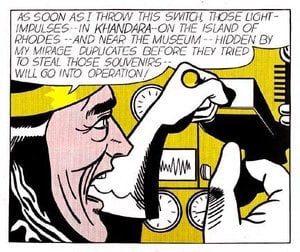
Edward Ruscha, a pivotal figure in the Pop Art movement, presents "Mad Scientist," a vibrant and intriguing work that encapsulates his signature style. Born in Omaha, Nebraska, Ruscha's artistic journey led him to Los Angeles where he honed his skills at the Chouinard Art Institute (now California Institute of the Arts). His exploration of American landscapes, typography, and vernacular language has cemented his place as an influential artist.
Subject Matter & Composition
"Mad Scientist" depicts a man seemingly immersed in scientific experimentation. The central figure, clad in a lab coat, playfully sports a beaker atop his head – a whimsical touch that immediately establishes the painting's quirky and unconventional nature. He is surrounded by an array of scientific paraphernalia: microscopes, test tubes, hinting at a chaotic yet fascinating laboratory setting. Ruscha’s composition isn’t about meticulous realism; instead, it prioritizes visual impact and a sense of playful absurdity.
Style & Technique
The painting firmly aligns with Pop Art principles. Ruscha employs bold colors—predominantly orange, blue, green, and yellow—to create a visually striking composition. The background features a colorful gradient that enhances the overall vibrancy and contributes to the piece's energetic atmosphere. Ruscha’s technique is characterized by its flatness and lack of traditional perspective, further emphasizing the Pop Art aesthetic which rejected academic artistic conventions in favor of imagery drawn from popular culture.
Historical Context & Symbolism
Emerging in the 1960s, Pop Art challenged the dominance of Abstract Expressionism. Artists like Ruscha sought to incorporate everyday objects and commercial imagery into their work, reflecting a shift towards consumerism and mass media. "Mad Scientist" can be interpreted as a commentary on the burgeoning scientific advancements of the era, perhaps with a touch of satirical humor regarding the perceived eccentricities often associated with scientists. The “mad” descriptor suggests a departure from conventional norms, embracing experimentation and unconventional thinking.
Emotional Impact & Appeal
"Mad Scientist" evokes a sense of playful chaos and quirky fascination. The vibrant colors and unusual imagery create an engaging visual experience that is both humorous and thought-provoking. The painting’s appeal lies in its ability to blend the familiar (the lab coat, scientific equipment) with the unexpected (the beaker as a hat), resulting in a work that is instantly memorable and endlessly intriguing. It's a piece that sparks curiosity and invites viewers to embrace the unconventional.
الأسئلة والأجوبة
كيف يمكنني الحصول على نسخة رقمية من "Mad scientist" للفنان إدوارد جوزيف روشا الرابع؟
تتوفر "Mad scientist" كـ تحميل صورة رقمية عالية الدقة، ويمكن شراؤها مباشرة من صفحة صورة رقمية الخاصة بها.
هل يمكنني مشاهدة "Mad scientist" كعرض شرائح بملء الشاشة؟
يمكن مشاهدة العرض المتتابع لـ "Mad scientist" في صفحة عرض متتابع الخاصة بالعمل الفني.
إلى أي حركة فنية ينتمي العمل "Mad scientist" للفنان إدوارد جوزيف روشا الرابع؟
"Mad scientist" هو عمل ينتمي إلى مدرسة Pop Art. وتُشير هذه المدرسة إلى التقليد الفني الذي يندرج ضمنه هذا العمل.



 معاينة الحجم الواقعي
 اطلب نسخة مرسومة يدويًا
 إرسال
إرسال مشاركة
 عرض التفاصيل
 دليل الأعمال الفنية للطلاب

 تحميل
تحميل
 قطع مشابهة
 الأشعة السينية
 عرض شرائح متتابع
 الإحصائيات
 اقرأ المزيد






































 خيار الزجاج متاح فقط للمقاسات التي تقل عن 110 سم