A Nocturne of Longing and Shadow: Unveiling Edvard Munch’s Moonlight
Edvard Munch's Moonlight, painted in 1893, isn’t merely a depiction of a coastal landscape; it’s a profound exploration of the human psyche, rendered with the raw intensity characteristic of Expressionism and Symbolism. This evocative work, housed within the Nasjonalmuseet in Oslo, invites viewers into a world steeped in melancholy, isolation, and an almost palpable sense of yearning. Munch, deeply influenced by personal tragedies – the early deaths of his mother and sister from tuberculosis, and the looming fear of inherited mental illness – channeled these experiences into his art, creating images that resonate with a visceral emotional truth. Moonlight exemplifies this perfectly, offering a glimpse into the artist’s inner world and inviting us to contemplate our own vulnerabilities.

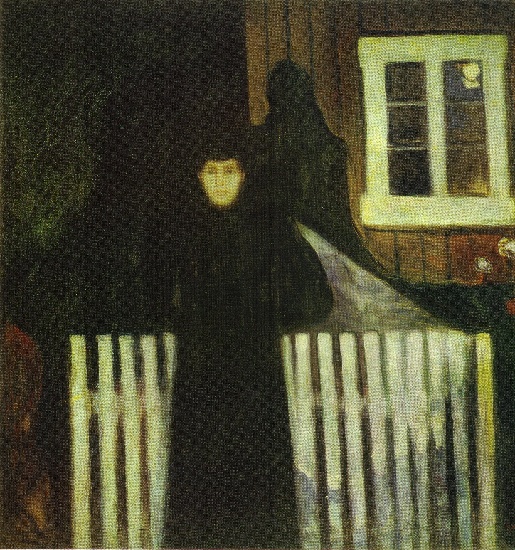
(Image of Moonlight by Edvard Munch)
The Language of Emotion: Style and Technique
Painted during the height of the Symbolist movement, Moonlight showcases Munch’s signature style—a deliberate departure from realistic representation in favor of subjective experience. The composition is dominated by undulating lines and a palette of cool blues, greys, and blacks, creating an atmosphere of subdued drama. The central figure, a woman standing on a porch, is rendered with simplified forms, her face partially obscured by a veil or mask, adding to the sense of mystery and detachment. Notice how Munch employs loose brushstrokes and distorted shapes—a hallmark of Expressionism—to convey not just the appearance of the scene but also the emotional state it evokes. The painting’s power lies in its ability to bypass rational understanding and directly access the viewer's feelings, particularly those associated with loneliness and introspection.
Technically, Munch utilizes a technique that blends elements of Impressionism with Symbolist aesthetics. He captures the fleeting effects of moonlight on the landscape—the shimmering reflections on the water, the soft glow illuminating the fence—but imbues these observations with symbolic weight. The darkness surrounding the figure suggests an oppressive atmosphere, while the single window offers a fragile point of light, representing perhaps hope or remembrance.
A Symbolist Vision: Interpreting the Imagery
Moonlight is rich in symbolism, inviting multiple interpretations. The woman’s masked face immediately draws attention to her anonymity and isolation. She represents not necessarily an individual but rather a universal archetype—a figure of longing, vulnerability, and perhaps even mourning. The porch itself can be seen as a liminal space, a threshold between the known world and an unknown realm of emotions. The two figures in the background, partially obscured by shadow, add to the sense of unease and suggest the presence of unseen forces.
Munch’s use of color is particularly significant. The cool blues and greys evoke a feeling of sadness and introspection, while the subtle hints of yellow represent fleeting moments of warmth or memory. The painting's title itself—Moonlight—suggests a connection to the subconscious, as moonlight is often associated with dreams, intuition, and hidden emotions.
Historical Context: Munch’s Legacy
Edvard Munch (1863-1944) was a pivotal figure in modern art, profoundly influenced by his personal experiences and the intellectual currents of his time. His work reflects the anxieties and uncertainties of the late 19th century—a period marked by rapid industrialization, social upheaval, and growing awareness of psychological distress. Munch’s exploration of themes such as death, illness, love, and anxiety anticipated many of the concerns that would dominate 20th-century art. His influence can be seen in the works of countless artists who followed, including Van Gogh, Kirchner, and Nolde.
To explore more artworks by Edvard Munch, including *The Scream* and other notable pieces, visit WahooArt.com, your trusted source for hand-made oil painting reproductions. The Nasjonalmuseet in Oslo, Norway, houses several of Munch’s works, including Moonlight. For more information on the museum and its collection, visit WahooArt.com.



 معاينة الحجم الحقيقي
 اشترِ نسخة مطبوعة
 مشاركة
 مشاركة
 التفاصيل

 تحميل الملف
 قطع مشابهة
 الأشعة السينية
 عرض شرائح

 عرض المزيد






































 خيار الزجاج متاح فقط للمقاسات التي تقل عن 110 سم