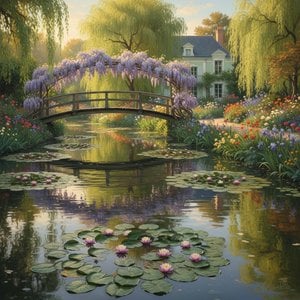
A Serene Reflection: Delving into Monet’s “Water Lilies (19)”
Claude Monet's "Water Lilies (19)," painted in 1905, isn’t merely a depiction of a pond; it’s an immersion into the very essence of light, color, and tranquility. This iconic work, residing within the vast series that dominated Monet’s final decades, captures a moment suspended in time – a shimmering surface reflecting the sky, trees, and the dappled sunlight filtering through the foliage. The painting immediately evokes a sense of profound peace, inviting the viewer to step into this idyllic world and lose themselves in its delicate beauty. It's a testament to Monet’s revolutionary approach to capturing fleeting impressions, moving beyond strict representation towards an exploration of pure sensation.
At the heart of “Water Lilies (19)” lies Monet’s signature Impressionist style. Short, broken brushstrokes dance across the canvas, creating a vibrant tapestry of color that shifts and changes with every glance. The artist masterfully employed oil on canvas to achieve this remarkable effect, layering pigments in thin glazes that allow light to penetrate and refract, mimicking the way sunlight interacts with water. Notice how he doesn’t attempt to precisely render each individual lily or leaf; instead, he focuses on capturing their overall impression – the luminous quality of their petals, the subtle variations in color, and the way they dissolve into the surrounding reflections. The greens are not uniform but a symphony of hues, from deep emeralds to pale celadons, while the blues of the sky and water blend seamlessly together.
The Giverny Garden: A World of Inspiration
To fully appreciate “Water Lilies (19),” it’s crucial to understand its context within Monet's life and artistic journey. In 1883, he purchased a property in Giverny, France, transforming it into his personal sanctuary and an experimental garden. This garden became the primary subject of countless paintings, evolving over time as Monet meticulously cultivated water lilies, irises, and other plants. “Water Lilies (19)” was created during this period of intense creative exploration, reflecting the culmination of years spent observing and translating the beauty of his garden onto canvas. The pond itself, a carefully constructed feature of the landscape, served as a constantly changing subject – its appearance altered by weather, seasons, and the movement of water.
The painting’s composition is deceptively simple yet profoundly effective. Monet deliberately eschews traditional perspective, creating an almost dreamlike atmosphere where the boundaries between foreground and background blur. The horizon line is absent, drawing the viewer into a world of pure color and light. This deliberate ambiguity invites contemplation and encourages us to lose ourselves in the painting’s immersive quality. The arrangement of the lilies – some floating freely, others clustered together – adds to the sense of natural abundance and serenity.
Symbolism and Emotional Resonance
Beyond its aesthetic beauty, “Water Lilies (19)” is rich in symbolism. Water, a recurring motif in Monet’s work, represents fluidity, change, and the passage of time. The lilies themselves can be interpreted as symbols of purity, innocence, and rebirth – qualities that resonate deeply within the context of Monet's personal life, particularly after the loss of his beloved wife, Camille. The painting’s overall mood is one of quiet contemplation and peaceful acceptance. It’s a reminder to slow down, appreciate the beauty of nature, and find solace in the simple pleasures of life. The soft light and gentle reflections evoke a sense of nostalgia and longing, inviting us to connect with our own memories and emotions.
Reproductions of “Water Lilies (19)” offer a remarkable opportunity to bring this timeless masterpiece into your home or office. WahooArt’s hand-painted reproductions faithfully capture the original's vibrant colors, delicate brushstrokes, and atmospheric depth, allowing you to experience Monet’s vision in stunning detail. Consider framing it within a simple, elegant frame to further enhance its impact – a subtle nod to the artist’s commitment to capturing the essence of light and color.



 معاينة الحجم الحقيقي
 اشترِ لوحة مرسومة يدويًا
 مشاركة
 مشاركة
 التفاصيل

 تحميل الملف
 قطع مشابهة
 الأشعة السينية
 عرض شرائح
 الإحصائيات

 عرض المزيد






































 خيار الزجاج متاح فقط للمقاسات التي تقل عن 110 سم