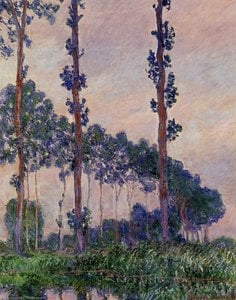
Juan-les-Pins
Claude Monet, one of the most renowned artists of the Impressionist movement, created a captivating landscape titled Juan-les-Pins in 1888. This painting is a testament to his ability to capture the essence of nature through vibrant colors and light.
The Painting's Composition
Monet’s masterful composition centers around tall trees with red leaves dominating the foreground, establishing a warm atmospheric hue. These trees possess an unusual purple shade, adding depth and dimension to the scene—a deliberate choice reflecting Monet’s fascination with capturing subtle nuances of color perception. In the background, a mountain rises majestically, further enhancing the landscape's natural grandeur and providing a striking contrast against the verdant foliage.
- Technique: Monet employed loose brushstrokes characteristic of Impressionism, prioritizing immediate visual sensation over meticulous detail. He layered pigments thinly onto canvas, allowing light to refract through the paint surface—a technique that brilliantly conveys the ephemeral beauty of the coastal environment.
- Color Palette: The painting’s palette is dominated by reds and purples, skillfully blended to evoke warmth and tranquility. Monet's use of complementary colors creates visual harmony and reinforces the impression of a sunny afternoon.
Impressionism and Landscape Painting
Monet was a pivotal figure in Impressionism, which fundamentally challenged artistic conventions by prioritizing capturing fleeting moments of light and color—a revolutionary concept at the time. His philosophy irrevocably altered landscape painting, shifting away from academic realism towards subjective interpretation. The Landscape Painting Art Movement has been a popular subject in Western art since the Renaissance, with roots tracing back to ancient Chinese and Japanese art.
Monet's Influence on Modernism
Oscar-Claude Monet (1840-1926) played an instrumental role in establishing Impressionist painting, profoundly influencing modernism. His core belief—that art should reflect immediate perception and the beauty of nature—particularly through outdoor (plein air) landscape art—transformed artistic approaches. Beyond Juan-les-Pins, other notable works by Monet include Lavacourt, The Church at Vetheuil, Snow, and The Japanese Bridge—each demonstrating his unwavering dedication to capturing the essence of visual experience.
Art Movements Influenced by Cubism
Cubism, pioneered by Pablo Picasso and Georges Braque, exerted considerable influence on subsequent art movements. The Cubism movement introduced collage as a groundbreaking artistic form and resonated with Futurism, Suprematism, Dada, Constructivism, De Stijl, and Art Deco—reflecting the broader intellectual currents of the early 20th century.
Conclusion
Claude Monet’s Juan-les-Pins stands as an enduring emblem of Impressionist artistry. Its luminous colors, expressive brushstrokes, and evocative depiction of coastal tranquility continue to inspire admiration and contemplation. For those seeking to immerse themselves in the splendor of Impressionism and its legacy on modern art, exploring Claude Monet’s oeuvre—particularly masterpieces like Lavacourt and The Church at Vetheuil—offers a captivating journey into the heart of artistic innovation.
To delve deeper into Impressionist painting's impact on Western art history, consider visiting The Metropolitan Museum of Art, which houses an unparalleled collection of Monet’s works alongside masterpieces from other influential artists.



 معاينة الحجم الحقيقي
 اشترِ لوحة مرسومة يدويًا
 مشاركة
 مشاركة
 التفاصيل

 تحميل الملف
 قطع مشابهة
 الأشعة السينية
 عرض شرائح

 عرض المزيد






































 خيار الزجاج متاح فقط للمقاسات التي تقل عن 110 سم