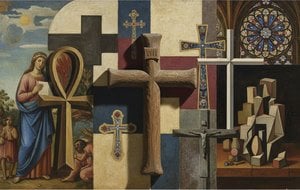
A Somber Journey: Exploring Claude Monet’s “Christ Bearing the Cross”
The image before us—a grayscale tableau of Christ enduring his burden—isn't merely a depiction of a biblical scene; it’s a profound meditation on suffering, faith, and the very essence of human experience. Attributed to the enigmatic Simon Marmion, a figure shrouded in the mists of 15th-century Valenciennes, this painting exists as one of a small group whose authenticity has been debated for centuries. While numerous illuminated manuscripts by Marmion are known, documented paintings remain scarce, adding an element of mystery and intrigue to its artistic legacy. The present piece, though demonstrably less accomplished than other works within the same grouping—such as the Crucifixion in the John G. Johnson Collection—offers a compelling glimpse into the artistic sensibilities of a pivotal yet elusive artist. Its stylistic kinship with a Christ before Caiaphas in the Johnson Collection hints at a shared hand and a consistent approach to portraying this iconic moment.
The composition is remarkably restrained, prioritizing clarity and solemnity over dramatic flourish. Christ dominates the frame, his figure diagonally traversing the canvas—a weighty presence borne aloft by the cross. Surrounding him are figures rendered with varying degrees of detail, receding into a landscape that anchors the scene: a stark, tower-like structure on the left provides vertical stability, while distant buildings and trees suggest a world both familiar and alien to Christ’s ordeal. The monochromatic palette—a spectrum ranging from deep blacks to subtle whites—immediately establishes an atmosphere of antiquity and gravity. There's no attempt at color here; instead, the artist masterfully employs shading and line work to evoke texture and volume, creating the illusion of draped fabric that folds with a convincing sense of weight and movement, and subtly suggesting the contours of Christ’s body beneath his garments.
The Hand of Marmion: Style and Technique
Examining the painting reveals a deliberate adherence to late medieval artistic conventions. Strong, defined lines delineate figures and architectural elements, contributing to an overall sense of structure and order. The cross itself is rendered with meticulous detail—a geometric form that serves as both a physical burden and a potent symbol. The use of line work and shading suggests a medium likely employed by Marmion – perhaps tempera or oil paint on wood panel, though definitive confirmation remains elusive. The flattened perspective, characteristic of the period, prioritizes clarity over spatial depth, creating a sense of immediacy that draws the viewer directly into the scene. Figures in the background are subtly diminished in size, reinforcing this lack of profound recession and focusing attention squarely on Christ’s central struggle.
Beyond mere representation, the painting communicates a deep well of emotion. The diffused lighting—lacking strong highlights or shadows—contributes to a sense of flatness, echoing the techniques prevalent in earlier artistic traditions. The posture of Christ, his head bowed and shoulders slumped under the weight of the cross, powerfully conveys sorrow, resignation, and sacrifice. This isn’t a triumphant depiction of salvation; it's an honest portrayal of suffering – a testament to the profound cost of redemption. The overall effect is deeply moving, inviting contemplation on themes of faith, pain, and human endurance.
Monet’s Shadow: A Curious Attribution
It’s crucial to acknowledge that this painting was initially attributed to Claude Monet, a name that seems incongruous given the monochromatic style. However, stylistic similarities—particularly in the use of line work and the emphasis on capturing light and shadow—have fueled speculation about a possible connection. While Monet is celebrated for his vibrant Impressionistic landscapes, this piece demonstrates a more restrained approach, echoing the artistic sensibilities of the late medieval period. Further research into Marmion’s oeuvre and the context surrounding this particular painting will undoubtedly shed further light on its origins and authorship. The attribution to Monet serves as a fascinating reminder of how artistic styles can evolve and influence one another across centuries.
This reproduction offers a unique opportunity to experience a significant work from a period often overlooked in art history. Its somber beauty, coupled with the mystery surrounding its creator, makes it a compelling addition to any collection or a thoughtful choice for interior design—a testament to the enduring power of religious imagery and the artistic skill of Simon Marmion.



 معاينة الحجم الحقيقي
 التحويل إلى المطبوعات
 مشاركة
 مشاركة
 التفاصيل

 تحميل الملف
 قطع مشابهة
 الأشعة السينية
 عرض شرائح
 الإحصائيات


 عرض المزيد






































 خيار الزجاج متاح فقط للمقاسات التي تقل عن 110 سم