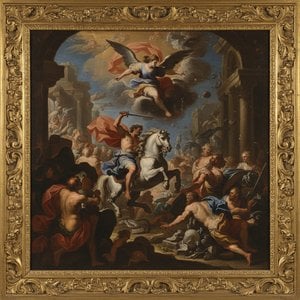
A Moment of Grace: Unveiling Caravaggio’s *Rest on the Flight into Egypt*
This captivating masterpiece by Michelangelo Merisi da Caravaggio, painted in 1596, offers a profoundly human glimpse into one of the most iconic stories from the New Testament – the Holy Family's desperate flight to Egypt. Currently housed within the prestigious Galleria Doria Pamphilj in Rome, *Rest on the Flight into Egypt* is not merely a religious depiction; it’s a testament to Caravaggio’s revolutionary approach to painting and his ability to imbue sacred narratives with raw emotion and startling realism.
Decoding the Composition & Narrative
The scene unfolds outdoors, bathed in a soft, yet dramatic light. The Virgin Mary is depicted tenderly cradling the infant Jesus, her expression one of serene exhaustion. Above them, an angel – strikingly youthful and beautiful – plays a viol, filling the air with music that symbolizes peace and divine protection. In the background, two figures attend to the necessities of their journey: one tending to a horse, the other playing a lute, adding layers of everyday life to this extraordinary event. The composition is carefully balanced, forming a subtle pyramidal structure that draws the viewer’s eye towards the central figures – Mary and Jesus. It's a moment of respite amidst peril, a fleeting instance of tranquility before continuing their arduous journey to safety.
Caravaggio’s Revolutionary Style: Tenebrism & Realism
*Rest on the Flight into Egypt* is a quintessential example of Caravaggio’s groundbreaking style. He was a pivotal figure in the Baroque period, rejecting the idealized forms of Mannerism in favor of unflinching realism. His signature technique, tenebrism, is powerfully evident here – a dramatic interplay of light and shadow that heightens the emotional intensity of the scene. The stark contrasts not only create depth and volume but also serve to focus attention on key elements, imbuing them with symbolic weight. Caravaggio’s commitment to depicting figures as they truly were—with imperfections and naturalistic features—was radical for his time and profoundly influenced generations of artists who followed. He didn't shy away from portraying the human side of religious figures, making their stories more relatable and emotionally resonant.
Symbolism & Hidden Meanings
Beyond its surface narrative, the painting is rich in symbolism. The angel’s music isn’t merely decorative; it represents divine harmony and hope amidst adversity. The landscape itself, though subtly rendered, suggests a wild and untamed world – mirroring the dangers faced by the Holy Family. Scholars have also noted that the musical score held by Joseph is a motet dedicated to the Virgin Mary, adding another layer of devotional meaning. The very act of *resting* signifies a temporary reprieve from fear, a moment to gather strength before facing the unknown. Some art historians believe Caravaggio subtly incorporated self-portraiture into his figures, further personalizing the narrative.
Historical Context & Artistic Legacy
Created during a period of religious and political upheaval, *Rest on the Flight into Egypt* reflects the anxieties and spiritual fervor of the late 16th century. Caravaggio’s innovative approach challenged artistic conventions and paved the way for the Baroque movement. His influence can be seen in the works of artists like Peter Paul Rubens, Rembrandt, and Jusepe de Ribera – all of whom adopted his dramatic use of light and shadow and his commitment to realism. The painting's enduring appeal lies not only in its artistic brilliance but also in its ability to connect with viewers on a deeply emotional level.
Emotional Impact & Interior Design Considerations
This artwork evokes feelings of serenity, vulnerability, and hope. The intimate portrayal of the Holy Family creates a sense of quiet contemplation, making it an ideal focal point for spaces designed for relaxation or reflection. Its rich color palette – deep reds, browns, and golds – adds warmth and sophistication to any interior. A high-quality reproduction of *Rest on the Flight into Egypt* would be particularly striking in libraries, living rooms, or private studies, lending a touch of timeless elegance and spiritual depth.
Exploring Further



 معاينة الحجم الواقعي
 اطلب نسخة مرسومة يدويًا
 إرسال
إرسال مشاركة
 عرض التفاصيل
 دليل الأعمال الفنية للطلاب

 تحميل
تحميل
 قطع مشابهة
 الأشعة السينية
 عرض شرائح متتابع
 الإحصائيات


 اقرأ المزيد






































 خيار الزجاج متاح فقط للمقاسات التي تقل عن 110 سم