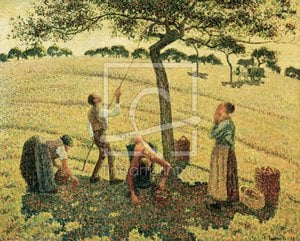
A Window into Rural Tranquility: Camille Pissarro’s “Mother Lucien’s Yard”
Camille Pissarro's "Mother Lucien’s Yard," painted in 1895, isn’t merely a depiction of a rural scene; it’s an invitation to step into a fleeting moment of quietude and observe the subtle poetry of everyday life. This Impressionist masterpiece, now held within a private collection, captures a pivotal intersection between labor, nature, and the enduring spirit of the French countryside. Pissarro, a key figure in the development of Impressionism, wasn’t interested in grand narratives or heroic displays; instead, he sought to distill the essence of experience – the light, the atmosphere, the simple rhythms of human activity – into vibrant brushstrokes.
The painting immediately draws the eye to a central grouping: a man diligently working alongside a pile of hay, likely utilizing it as mulch for his garden. This isn’t a portrait of strenuous labor, but rather an acknowledgment of the quiet dignity inherent in honest work. To his right stands a woman, her posture suggesting observation and perhaps gentle guidance – a subtle counterpoint to the solitary activity unfolding before her. Beyond them, a horse grazes peacefully in the background, hinting at a connection between human endeavor and the natural world, a common theme in Pissarro’s oeuvre.
Impressionistic Techniques: Light, Color, and Texture
Pissarro's mastery lies not just in his subject matter but in his execution. The painting is a testament to the Impressionist approach – an emphasis on capturing the *impression* of a scene rather than a photographic representation. Loose, broken brushstrokes dominate the canvas, creating a sense of movement and immediacy. Notice how light isn’t rendered as a static quality but as a dynamic force, constantly shifting and transforming the colors around it. The palette is dominated by earthy tones – ochres, browns, greens – punctuated by flashes of red and yellow, particularly in the hay and the figures' clothing. These vibrant accents draw the eye and add depth to the composition.
The texture itself is remarkably rich, achieved through the thick application of paint. Pissarro wasn’t afraid to build up layers of color, creating a tactile surface that invites close inspection. The brushstrokes aren’t blended smoothly; instead, they retain their individual character, contributing to the painting's overall sense of vitality and spontaneity.
Historical Context: A Moment in Time
"Mother Lucien’s Yard" was painted during a period of significant social and artistic change. Following the Franco-Prussian War, France experienced a renewed interest in rural life and a desire to reconnect with traditional values. Impressionism, with its focus on capturing fleeting moments and subjective experiences, resonated deeply with this sentiment. Pissarro himself spent much of his career documenting the landscapes and people of France, often depicting scenes of agricultural labor – a subject that held both economic and social significance.
The painting’s date (1895) places it firmly within the later years of Pissarro's artistic development. He had already established himself as a leading figure in Impressionism but was also experimenting with new techniques and approaches, foreshadowing the emergence of Post-Impressionism. His work during this period reflects a growing interest in capturing not just the visual appearance of a scene but also its emotional resonance.
Symbolic Resonance: The Quiet Dignity of Labor
Beyond its technical brilliance, “Mother Lucien’s Yard” carries a subtle symbolic weight. It's a celebration of the dignity of labor and the beauty of rural life – themes that were increasingly valued in a rapidly industrializing world. The painting suggests a harmony between humanity and nature, a reminder of our connection to the land and the rhythms of the seasons. The woman’s presence adds another layer of meaning, hinting at the role of women in maintaining the household and contributing to the family's well-being.
Ultimately, “Mother Lucien’s Yard” is more than just a painting; it’s an invitation to pause, reflect, and appreciate the simple pleasures of life. It’s a testament to Pissarro’s artistic vision and his ability to capture the essence of human experience with remarkable sensitivity and skill.



 معاينة الحجم الحقيقي
 اشترِ لوحة مرسومة يدويًا
 مشاركة
 مشاركة
 التفاصيل

 تحميل الملف
 قطع مشابهة
 الأشعة السينية
 عرض شرائح
 الإحصائيات

 عرض المزيد






































 خيار الزجاج متاح فقط للمقاسات التي تقل عن 110 سم