The Soul of Bronze: Rediscovering Antoine-Louis Barye’s Strength
In the grand tapestry of nineteenth-century sculpture, few threads shine with as much raw, emotive power as the works of Antoine-Louis Barye. While he is celebrated globally as the pioneer of the animalier genre—a master who breathed life into the ferocity of lions and the grace of predators—it is in his masterpiece, "Strength," that we encounter the profound depth of his humanistic vision. Created in 1854, this breathtaking sculpture transcends the boundaries of mere anatomical study to touch upon the very essence of the human condition. It is a work that does not merely sit upon a pedestal but commands the space around it, inviting the viewer into a silent dialogue between vulnerability and fortitude.
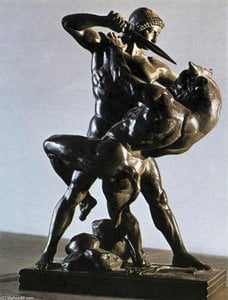
The composition of "Strength" is a masterclass in the Romantic tradition, capturing a moment of profound intimacy through a striking physical contrast. At its heart, the sculpture depicts a man of immense physical presence, his musculature rendered with such breathtaking accuracy that one can almost sense the tension and vitality within the bronze. Yet, this display of raw power is not directed toward conquest or aggression; instead, it is channeled into the tender act of cradling a child. This juxtaposition—the rugged, powerful form of the man against the delicate, fragile weight of the infant—creates a poignant tension that defines the piece. It is a visual poem about the protective nature of true strength, suggesting that the greatest use of power lies in the preservation of life and the nurturing of innocence.
Technical Mastery and the Romantic Spirit
To behold a high-quality reproduction of "Strength" is to appreciate the meticulous technical heritage of Barye’s craft. Having begun his journey as an apprentice goldsmith, Barye brought an unparalleled precision to the medium of bronze. He utilized the lost-wax casting technique, a method that allowed him to achieve an extraordinary level of surface smoothness and tonal richness. In this piece, every sinew of the male figure and every soft contour of the child is captured with a fidelity that honors the artist's obsession with anatomical truth. For the discerning collector or interior designer, such a piece offers more than just decoration; it provides a tactile sense of history and a sophisticated focal point that anchors a room with its classical weight.
The historical context of 1854 adds another layer of resonance to the work. Emerging from an era where the rigid formalities of Neoclassicism were giving way to the passionate, turbulent energy of Romanticism, Barye’s "Strength" embodies this transition perfectly. It retains the disciplined anatomical structure learned from his mentors at the École des Beaux-Arts, yet it is infused with a new, expressive movement and emotional depth. The sculpture does not just represent a man and a child; it represents an ideal—the heroic capacity for tenderness amidst a world of struggle. This enduring symbolism makes the work an evergreen choice for those seeking to infuse their living spaces with themes of resilience, legacy, and the timeless bond of care.
An Inspiration for Modern Interiors
For the art lover or the curator of fine interiors, "Strength" serves as a profound statement piece. Its presence in a gallery or a private study evokes a sense of permanence and intellectual depth. The dark, lustrous patina characteristic of Barye’s bronze work complements a wide array of sophisticated decor, from the heavy, traditional aesthetics of a classic library to the minimalist, clean lines of a contemporary loft. By integrating a reproduction of such a significant historical work, one brings into the home not just an object of beauty, but a piece of the nineteenth-century's most vital artistic revolution.
Ultimately, the impact of "Strength" lies in its ability to move the spectator. It is a work that rewards prolonged contemplation, revealing new nuances of light and shadow with every glance. Whether one is drawn to the technical brilliance of the musculature or the heart-wrenching tenderness of the subject matter, Barye’s creation remains an unparalleled testament to the idea that true strength is found in the capacity to protect, to hold, and to love.



 التحويل إلى المطبوعات
 مشاركة
 مشاركة
 التفاصيل

 تحميل الملف
 قطع مشابهة
 عرض شرائح
 الإحصائيات


 عرض المزيد