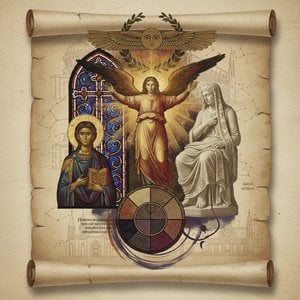
The Presentation by Andrea Mantegna: A Renaissance Echo of Antiquity
Andrea Mantegna’s “The Presentation at the Temple,” painted around 1455, stands as a cornerstone of Early Renaissance art—a testament to its fascination with classical ideals and meticulous observation of detail. More than just a depiction of biblical narrative, it embodies a profound intellectual engagement with Roman antiquity, reflecting Mantegna's formative years under Francesco Squarcione’s tutelage at Padua’s humanist workshop.
- Subject Matter: The artwork portrays the pivotal moment recounted in Luke 2:26-38 – Mary presenting Jesus at the Temple. Simeon, guided by divine prophecy, recognizes Christ as the Messiah, marking a fulfillment of Old Testament prophecies and initiating the Christian narrative of salvation.
- Style & Technique: Mantegna’s style is characterized by sculptural realism—a deliberate departure from Byzantine conventions—achieved through masterful use of linear perspective and meticulous modeling of forms. The painting employs tempera on panel, resulting in a surface texture that subtly captures the artist's brushstrokes, contributing to an overall sense of solidity and grandeur.
- Composition: The scene unfolds within a shallow depth of field, creating an immediacy that draws the viewer into the intimate tableau. Mantegna utilizes a pyramidal structure—Mary and Jesus at its apex—reflecting classical compositional principles and conveying stability and harmony.
The color palette leans heavily on earthy tones – browns, reds, and golds – accented by delicate whites and muted blues. These hues are strategically contrasted to highlight key figures like Mary’s pale skin and the infant Jesus’ crimson robe, emphasizing visual impact and conveying solemn reverence.
- Color Palette: Dominant earth tones (browns, reds, golds) with subtle accents of white and muted blues. Careful use of color enhances symbolic significance and contributes to emotional resonance.
- Lighting: Diffused illumination from an unseen source sculpts the figures’ forms, creating chiaroscuro—a technique borrowed from classical sculpture—that emphasizes textures and adds dramatic depth.
Beyond its formal elements, “The Presentation” resonates with profound symbolic meaning. The aureola encircling Mary, Jesus, and Simeon signifies holiness and divine grace, while the expressions on their faces convey tenderness, piety, and unwavering faith—capturing the essence of spiritual contemplation.
- Symbolism: Haloes represent sanctity; facial expressions embody reverence and faith. The scene symbolizes fulfillment of prophecy and embodies Christian spirituality.
Mantegna’s dedication to accuracy—evident in the detailed rendering of drapery folds, skin tones, and architectural elements—reflects a humanist impulse rooted in the rediscovery of classical knowledge. This artwork remains an enduring emblem of Renaissance artistic ambition: a courageous attempt to revive the grandeur and intellectual rigor of Rome amidst the burgeoning cultural landscape of Florence and Padua.



 معاينة الحجم الحقيقي
 التحويل إلى المطبوعات
 مشاركة
 مشاركة
 التفاصيل

 تحميل الملف
 قطع مشابهة
 الأشعة السينية
 عرض شرائح
 الإحصائيات


 عرض المزيد






































 خيار الزجاج متاح فقط للمقاسات التي تقل عن 110 سم