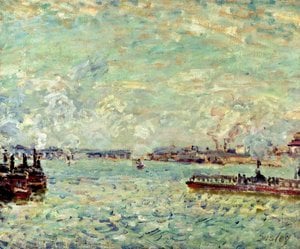
A Moment Frozen in Light: Alfred Sisley's The Moret Bridge
- Subject Matter
- Style and Technique
- Historical Context & Impressionism
- Symbolic Resonance & Emotional Impact
The Moret Bridge, painted by Alfred Sisley in 1892, is more than just a depiction of a charming French riverside town; it’s an exquisite encapsulation of the Impressionist philosophy – a fleeting moment captured and imbued with light, atmosphere, and a profound sense of tranquility. Measuring 33 x 41 cm, this oil on canvas work invites the viewer into a serene scene dominated by the graceful curve of the Moret Bridge spanning a gently flowing river. The composition is meticulously balanced, drawing the eye to the prominent church steeple that anchors the skyline, while the clustered buildings along the bank evoke a sense of timeless village life. Two boats, strategically placed near the bridge, add subtle dynamism and reinforce the feeling of an everyday scene brought vividly to life. Sisley’s masterful use of color – predominantly muted browns, blues, and greens – perfectly reflects the natural environment, creating a harmonious blend with the architectural elements.
Decoding Impressionist Technique
At the heart of The Moret Bridge lies Sisley's dedication to Impressionist technique. Notice the deliberate application of loose, visible brushstrokes; this isn’t an attempt at photographic realism but rather an exploration of how light and color interact. The artist expertly captures the play of sunlight on the water, creating shimmering reflections that dance across the surface. Similarly, he subtly renders the textures of the buildings – the rough stone, the weathered wood – through layered paint application, giving a tangible sense of materiality. This technique, characteristic of Impressionism, isn't simply about what is seen; it’s about *how* it is perceived – the immediate sensory experience of light and color. The flattened perspective, a hallmark of the movement, further enhances this immersive quality, drawing the viewer into the scene as if they were standing on the riverbank themselves.
A Window into 19th-Century France
Painted in 1892, The Moret Bridge offers a poignant glimpse into late 19th-century French life. Sisley’s focus on landscapes and everyday scenes – bridges, rivers, small towns – reflects a broader trend within the Impressionist movement: a desire to move away from grand historical or mythological subjects and instead capture the beauty of ordinary moments. The painting speaks to a time when artists were increasingly interested in exploring the effects of light and atmosphere, rejecting traditional academic approaches to representation. Sisley’s work aligns with his contemporaries, Monet, Renoir, and Pissarro, all of whom sought to revolutionize art by prioritizing subjective perception over objective reality.
Beyond the Surface: Symbolism and Emotional Resonance
The Moret Bridge transcends a simple landscape painting; it evokes a powerful sense of nostalgia, tranquility, and perhaps even a wistful contemplation of rural life. The bridge itself – a symbol of connection and transition – subtly reinforces this feeling. The scene’s stillness and the soft light contribute to an atmosphere of peace and serenity, inviting the viewer to escape the bustle of modern life and immerse themselves in a moment of quiet beauty. Sisley's ability to transform a seemingly mundane setting into a captivating work of art speaks to his profound understanding of human emotion and his remarkable artistic skill. Considered alongside related works like *The Loing Flowing under the Moret Bridge* and *The Moret Bridge and Mills under Snow*, The Moret Bridge solidifies Sisley’s place as a pivotal figure in the Impressionist movement, demonstrating his enduring ability to capture the essence of light, color, and the beauty of the natural world.



 معاينة الحجم الحقيقي
 اشترِ نسخة مطبوعة
 مشاركة
 مشاركة
 التفاصيل

 تحميل الملف
 قطع مشابهة
 الأشعة السينية
 عرض شرائح


 عرض المزيد






































 خيار الزجاج متاح فقط للمقاسات التي تقل عن 110 سم