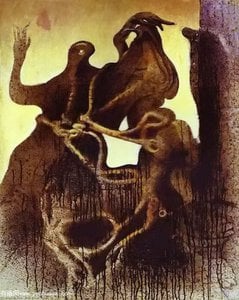
The Shadow Painter of Symbolism and Expressionism
Alfred Leopold Isidor Kubin stands as a singular, haunting figure in the annals of Austrian art history, a master whose brush and needle seemed to navigate the darkest corridors of the human psyche. Born in 1877 in Leitmeritz, Bohemia, Kubin’s life was inextricably linked to the landscapes of his own imagination—landscapes often populated by grotesque creatures, shadowy figures, and an overwhelming sense of existential dread. His early years were marked by profound personal turbulence; a near-fatal suicide attempt following the loss of his mother and subsequent mental instability during his military service forged an artist profoundly attuned to the inner landscapes of fear, grief, and the subconscious mind.
Before he became a titan of the Symbolist movement, Kubin’s formative years included a brief apprenticeship under the photographer Alois Beer. While he gained little practical skill in the photographic arts, this early exposure to light and shadow likely informed the tonal subtlety that would later define his graphic work. His artistic journey truly ignited during his studies at the Munich Academy, where he encountered the revolutionary visions of Odilon Redon, Edvard Munch, and James Enscor. It was here that he found a kindred spirit in the works of Max Klinger, whose mastery of the aquatint technique left an indelible mark on Kubin’s style, inspiring him to pursue a method that prioritized psychological depth and atmospheric density over mere representation.
A Visionary of the Subconscious
Kubin’s artistic output was a deliberate exploration of the dream world, primarily expressed through pen and ink drawings, watercolors, and lithographs. He eschewed the bright palettes of his contemporaries in favor of a monochromatic or muted spectrum that allowed for the creation of murky, unsettling atmospheres. His work often feels like a window into a fever dream, where the boundaries between reality and nightmare are perilously thin. This fascination with the irrational and the macabre placed him at the forefront of both Symbolism and the burgeoning Expressionist movement.
The themes within his oeuvre are as recurring as they are unsettling:
- The Grotesque and the Fantastic: His prints are frequently populated by chimeric beasts and distorted human forms that evoke a sense of primordial terror.
- Psychological Torment: Works such as Self-Reflection (c. 1902) utilize headless figures and fragmented bodies to mirror the disintegration of the self.
- Allegorical Landscapes: Environments like those seen in The Swamp serve not just as settings, but as metaphors for the murky, impenetrable depths of the human soul.
Beyond his graphic mastery, Kubin was also a gifted writer, most notably composing the single novel The Other Side (Die andere Seite). This allegorical work serves as a literary companion to his visual art, mirroring the same themes of displacement and the haunting presence of an unseen, darker reality. His ability to bridge the gap between the written word and the visual image solidified his reputation as a complete creator of mythic worlds.
Legacy and Historical Significance
The historical significance of Alfred Kubin extends far beyond the borders of Austria. He was a pivotal figure whose work bridged the gap between the late 19th-century Symbolist obsession with myth and the early 20th-century Expressionist focus on raw, emotional truth. His influence can be traced through the works of other masters; notably, his dark, atmospheric style resonated deeply with Franz Kafka, whose own literary explorations of bureaucracy and nightmare share a spiritual kinship with Kubin’s visual nightmares.
Throughout his career, Kubin achieved international recognition, illustrating the works of legendary authors such as Fyodor Dostoevsky and Edgar Allan Poe. His membership in prestigious institutions, including the Prussian Academy of Arts in Berlin and the Bavarian Academy of Fine Arts, underscores the respect he commanded within the European art establishment. Even as the world moved through the upheavals of the two World Wars, Kubin’s work remained a steadfast exploration of the eternal shadows that reside within us all. Today, he is remembered not merely as a printmaker, but as an architect of the subconscious, a painter who dared to give form to the fears that most of humanity seeks to keep hidden.



 معاينة الحجم الحقيقي
 التحويل إلى المطبوعات
 مشاركة
 مشاركة
 التفاصيل

 تحميل الملف
 قطع مشابهة
 الأشعة السينية
 عرض شرائح
 الإحصائيات
 عرض المزيد