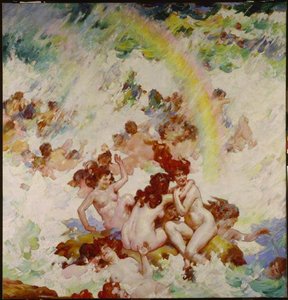
A Canadian Pioneer of Impressionism
William Blair Bruce, born in Hamilton, Ontario, in 1859, occupies a pivotal yet often understated position within the narrative of Canadian art history. He wasn’t merely *a* Canadian Impressionist; he was among the very first to embrace and cultivate the style within the nation's artistic landscape, bridging European avant-garde movements with a uniquely North American sensibility. His life reads as a compelling journey—from early aspirations in law and architecture to a dedicated pursuit of painting that led him across continents, ultimately finding solace and inspiration on the shores of Sweden’s Gotland island. Bruce’s story is one of artistic conviction, resilience in the face of hardship, and a profound connection to both the natural world and the evolving currents of modern art.
From Academic Foundations to Parisian Light
Bruce's initial path wasn’t immediately set on artistry. He initially pursued legal studies at Hamilton Collegiate Institute before briefly exploring architecture at the Mechanics Institute. However, a latent artistic talent, nurtured by his father—a skilled calligrapher and amateur painter—and local artists like John Herbert Caddy and Henry Martin, steadily drew him toward a life dedicated to visual expression. In 1881, with crucial familial support, Bruce embarked on a transformative journey to Paris, the epicenter of the art world at the time. He enrolled at the prestigious Académie Julian, immersing himself in classical training under Adolphe-William Bouguereau and Tony Robert-Fleury. This academic grounding provided him with a solid foundation in draftsmanship and composition, skills he would later skillfully adapt as his artistic vision evolved.
However, Paris offered more than just formal instruction. Bruce sought out the burgeoning artist colonies of Barbizon and Grèz-sur-Loing, where he began experimenting with *plein air* painting—a technique emphasizing direct observation of nature and capturing its fleeting effects of light and atmosphere. Early Salon exhibitions brought some recognition, notably for “Temps Passé” (1884), but also underscored the financial struggles inherent in a life devoted to art. A devastating blow came in 1885 when the steamship Brooklyn sank, claiming approximately two hundred of his paintings—a heartbreaking loss that tested his resolve. Yet, Bruce persevered, and a pivotal moment arrived in 1887 with his time spent in Giverny alongside Theodore Robinson and Willard Metcalf. It was here, in close proximity to Claude Monet, that he fully embraced Impressionism, adopting its brighter palette and focusing on the ephemeral qualities of light—a shift that would define his artistic trajectory.
Love, Legacy, and the Creation of Brucebo
A significant turning point in Bruce’s life occurred with his marriage to Carolina Benedicks, a Swedish sculptor, in 1888. She became not only his wife but also a vital source of support, inspiration, and companionship. Together, they sought a haven where they could both create and nurture their artistic pursuits. This search led them to the idyllic island of Gotland, Sweden, where around 1900 they began building Brucebo—a summer home that gradually evolved into an artists’ estate. Brucebo wasn't merely a residence; it was conceived as a sanctuary for creativity, a place where art and nature intertwined harmoniously. The couple meticulously designed the gardens and surrounding landscape to inspire artistic expression, creating a unique environment that attracted fellow artists and fostered a vibrant creative community.
Brucebo became more than just an estate—it transformed into a nature reserve and museum dedicated to preserving Bruce’s legacy and showcasing his work. Today, it stands as a testament to their shared vision and enduring commitment to art and the natural world. The estate embodies the spirit of artistic collaboration and environmental stewardship that characterized their lives.
A Lasting Impression on Canadian Art
William Blair Bruce’s historical significance lies in his role as a pioneer, introducing Impressionistic techniques to Canada at a time when the art world was undergoing radical transformation. He wasn't simply imitating European styles; he adapted them to reflect the unique character of the Canadian landscape and infused them with his own artistic sensibility. His influence extended beyond his paintings, impacting many young artists who sought guidance and inspiration from him. The Art Gallery of Hamilton, founded in part through generous donations from his widow Carolina, stands as a lasting tribute to his enduring legacy.
While initially overlooked by some art historians, Bruce’s work has experienced a resurgence in recent decades, solidifying his place as an important figure in Canadian art history. His luminous landscapes and seascapes—characterized by their vibrant colors, delicate brushwork, and evocative atmosphere—continue to captivate audiences today. He demonstrated that it was possible to be both a globally aware artist and deeply rooted in the specificities of one’s own cultural context. He remains a compelling example of an artist who dared to forge his own path, embracing innovation while remaining true to his artistic vision.