A Brush with Serenity: The Life and Art of Wang Xuehao
Wang Xuehao, a name perhaps less familiar in the West than some of his more celebrated contemporaries, stands as a significant figure within the landscape traditions of the Qing Dynasty (1644-1911). Born in Beijing in 1754, he lived through a period of both imperial grandeur and subtle shifts in artistic taste. While biographical details remain somewhat sparse, what *is* known paints a picture of an artist deeply immersed in the scholarly culture of his time, a master of ink on paper who found particular expression in the intimate formats of folding fans and handscrolls. His life unfolded against the backdrop of the Qianlong and Jiaqing reigns, eras marked by both patronage of the arts and increasing social complexity. He passed away in 1832, leaving behind a legacy that continues to resonate with collectors and connoisseurs today.
The Scholar-Artist and the Qing Landscape
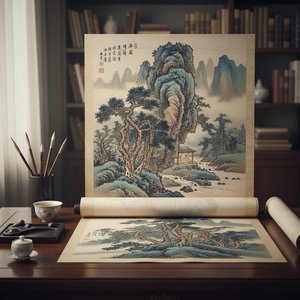
Wang Xuehao’s art is inextricably linked to the traditions of *shanshui* painting – literally “mountain-water” – which had been central to Chinese artistic expression for centuries. This wasn't merely a depiction of scenery; it was a philosophical pursuit, an attempt to capture the essence of nature and its underlying principles. Artists sought not photographic realism but rather to convey the spirit of the landscape, often imbued with Daoist or Buddhist symbolism. Wang Xuehao excelled in this tradition, demonstrating a refined sensitivity to atmospheric effects and a masterful control of ink wash techniques. He wasn’t simply *representing* mountains and water; he was evoking a sense of tranquility, solitude, and harmony. His works frequently feature layered landscapes, suggesting depth and distance, with delicate brushwork that captures the subtle nuances of light and shadow. He became part of Ruan Yuan's network in the 1790s, undertaking commissioned paintings for him, notably a set created in 1794.
Master of Miniature Worlds: Folding Fans and Handscrolls
While proficient in larger formats, Wang Xuehao truly distinguished himself as a master of smaller mediums – particularly the folding fan mounted as an album leaf and the handscroll. These were not merely scaled-down versions of his larger works; they demanded an even greater degree of precision and control. The limited space required him to distill his compositions to their essential elements, creating intensely focused scenes that rewarded close contemplation. The folding fan, in particular, was a popular format among scholars and officials, often used for personal expression or as gifts. Wang Xuehao’s fans are remarkable for their exquisite detail and poetic sensibility. The handscroll allowed for a more narrative approach, unfolding gradually to reveal a continuous landscape vista. His ability to create a sense of expansive space within the confines of a scroll is testament to his skill and imagination.
Influences and Artistic Development
Pinpointing specific influences on Wang Xuehao’s style proves challenging due to limited documentation, but it's clear he drew upon the rich heritage of earlier landscape masters. The traditions of the Yuan Dynasty (1271-1368) painters – artists like Huang Gongwang and Wang Meng – likely played a role in shaping his approach to composition and brushwork. He also appears to have been influenced by the literati painting tradition, which emphasized personal expression and intellectual depth over mere technical virtuosity. His landscapes often incorporate calligraphic inscriptions, adding another layer of meaning and reflecting his scholarly background. While he adhered to traditional conventions, Wang Xuehao wasn’t simply a copyist; he infused his works with his own unique sensibility, creating a style that is both refined and deeply personal.
Legacy and Historical Significance
Although not as widely recognized internationally as some of his peers, Wang Xuehao occupies an important place in the history of Qing Dynasty painting. His mastery of ink landscape techniques, particularly within the intimate formats of folding fans and handscrolls, has earned him a devoted following among collectors and scholars. His works offer a glimpse into the aesthetic sensibilities of the scholar-official class during a period of significant social and political change. In 1994, he was elected as a member of the Chinese Academy of Engineering – a testament to his enduring influence and recognition within Chinese artistic circles. Today, his paintings are held in major museum collections around the world, including The Metropolitan Museum of Art, offering modern audiences a chance to experience the serenity and beauty of his art. His landscapes continue to inspire contemplation and appreciation for the power of *shanshui* painting as a profound expression of both nature and the human spirit.