The Disciplined Vision: The Artistic Journey of Wang Jianwei
To understand the profound depth of Wang Jianwei, one must first look toward the disciplined landscapes of his youth. Born in October 1954 within the Xinhuang Dong Autonomous County of Hunan Province, Wang’s early life was defined by the rigid structures of military tradition. Growing up as the son of soldiers within the People’s Liberation Army (PLA), he inhabited a world where precision, observation, and duty were paramount. This formative period, characterized by the stark realities of military camps, instilled in him a meticulous eye for detail—a quality that would later become the bedrock of his complex explorations into new media, performance, and installation art.
The trajectory of his life was irrevocably altered by the turbulent winds of history. Following the onset of the Cultural Revolution, Wang experienced the profound dislocations of a changing China, including a period of rural reeducation that brought him into contact with the raw, unvarnished textures of countryside life. It was during these years that his creative seeds were first sown; through private painting lessons from a local stage designer, he began to master the language of realism. This foundation in classical technique would eventually serve as a striking counterpoint to the avant-garde provocations of his later career.
From Military Precision to Avant-Garde Expression
Wang’s transition from a military engineer and operations specialist to a pioneer of contemporary Chinese art is a narrative of remarkable metamorphosis. After his service in the PLA, his encounter with the Zhejiang Academy of Fine Arts (now the China Academy of Art) acted as a gateway to the global contemporary art discourse. Under the mentorship of influential figures like Zheng Shengtyp, who brought the radical energy of Western contemporary art to China, Wang began to transcend the boundaries of traditional canvas. He found himself drawn to the immersive potential of installation and environmental art, seeking ways to make the viewer an active participant in the work.
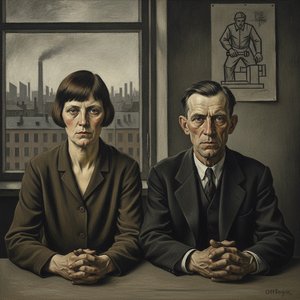
His artistic evolution is marked by a fascinating synthesis of disparate influences. While he embraced the experimental nature of new media, he remained deeply connected to the Sichuan Painting School style, which emphasized the poignant, realistic depiction of everyday existence. This unique stylistic blend—merging the visceral, expressive weight of artists like Francis Bacon with the cutting-edge possibilities of digital and performance art—allowed him to create works that are both intellectually demanding and emotionally resonant. His celebrated piece, "Bentham," stands as a testament to this ability, capturing a sense of quietude and profound observation through a lens of stylistic complexity.
A Legacy of Interdisciplinary Innovation
Today, Wang Jianwei is recognized as a pivotal figure in the landscape of contemporary Chinese art, a creator whose work bridges the gap between historical memory and future technological possibilities. His practice does not merely exist within a single medium; rather, it flows across the boundaries of performance, sculpture, and digital media to interrogate the very nature of perception and cultural identity. By weaving together the discipline of his military past with the fluid, often chaotic realities of modern life, he has constructed a visual language that is uniquely his own.
The historical significance of Wang’s work lies in its ability to navigate the complexities of a rapidly transforming society. His art serves as a profound meditation on:
- The intersection of individual memory and national history, reflecting how personal experiences are shaped by larger political shifts.
- The evolution of medium, moving from the tactile reality of pen drawings and sketches to the ephemeral nature of performance and new media installations.
- The tension between tradition and modernity, utilizing classical realist foundations to explore contemporary, often abstract, conceptual themes.
Through his unwavering commitment to meticulous observation and deep cultural engagement, Wang Jianwei continues to challenge our understanding of what art can be, ensuring his place as a vital voice in the global contemporary dialogue.